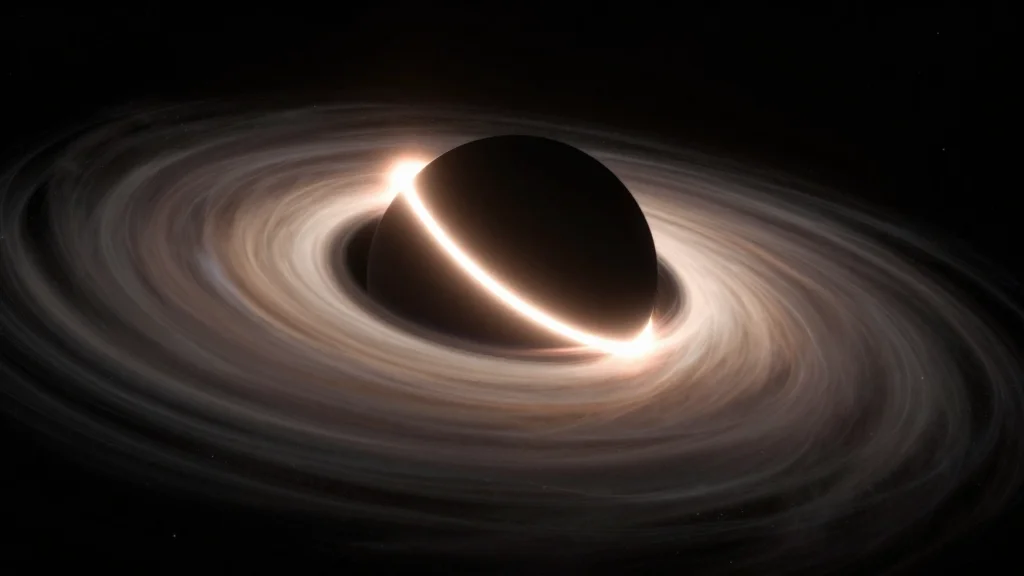
Shredded Stars Reveal How Black Holes Ignite Trillion-Sun Flares
Why It Matters
Understanding the mechanics of TDEs gives astronomers a direct probe of otherwise invisible supermassive black holes, improving mass‑ and spin‑measurements that are critical for galaxy‑evolution models.
Key Takeaways
- •Simulations used tens of billions of particles for unprecedented detail
- •Debris forms a narrow, coherent stream that self‑intersects
- •Black‑hole spin induces nodal precession, altering flare timing
- •Flare brightness can reach energy of one trillion Suns
- •TDE diversity likely stems from spin and orbital orientation
Pulse Analysis
Tidal disruption events have long been the brightest beacons for studying dormant supermassive black holes, yet their light curves have resisted a unified physical explanation. Traditional models struggled with low‑resolution simulations that smeared the stellar debris, obscuring the precise mechanisms that convert gravitational energy into observable radiation. The latest work, leveraging smoothed particle hydrodynamics on GPU‑accelerated supercomputers, resolves the debris stream at a scale previously unattainable, revealing a tightly wound filament that repeatedly collides with itself. This self‑intersection concentrates shock heating and fuels rapid accretion, generating the trillion‑Sun‑luminosity flares that briefly dominate their host galaxies.
Beyond the sheer visual spectacle, the study highlights the pivotal role of black‑hole spin. A rotating black hole warps spacetime, causing nodal precession that nudges the debris out of its original orbital plane. Depending on spin magnitude and orientation, the stream may miss itself for several orbits before finally intersecting, delaying the flare onset by weeks or months. This nuanced dynamical picture accounts for the wide range of rise times, peak luminosities, and decay slopes observed across TDEs, suggesting that spin is a primary driver of their diversity alongside mass.
The implications for observational astronomy are immediate. With next‑generation facilities such as the Vera C. Rubin Observatory, the European Athena X‑ray mission, and the James Webb Space Telescope poised to capture TDEs across the electromagnetic spectrum, astronomers can now invert detailed light‑curve features to infer black‑hole spin and orientation. Accurate spin measurements feed directly into models of black‑hole growth, feedback, and the co‑evolution of galaxies. As simulation fidelity continues to climb, the synergy between theory and high‑cadence surveys promises to turn these once‑mysterious flares into precise diagnostics of the universe’s most massive invisible engines.
Shredded stars reveal how black holes ignite trillion-sun flares
Comments
Want to join the conversation?
Loading comments...