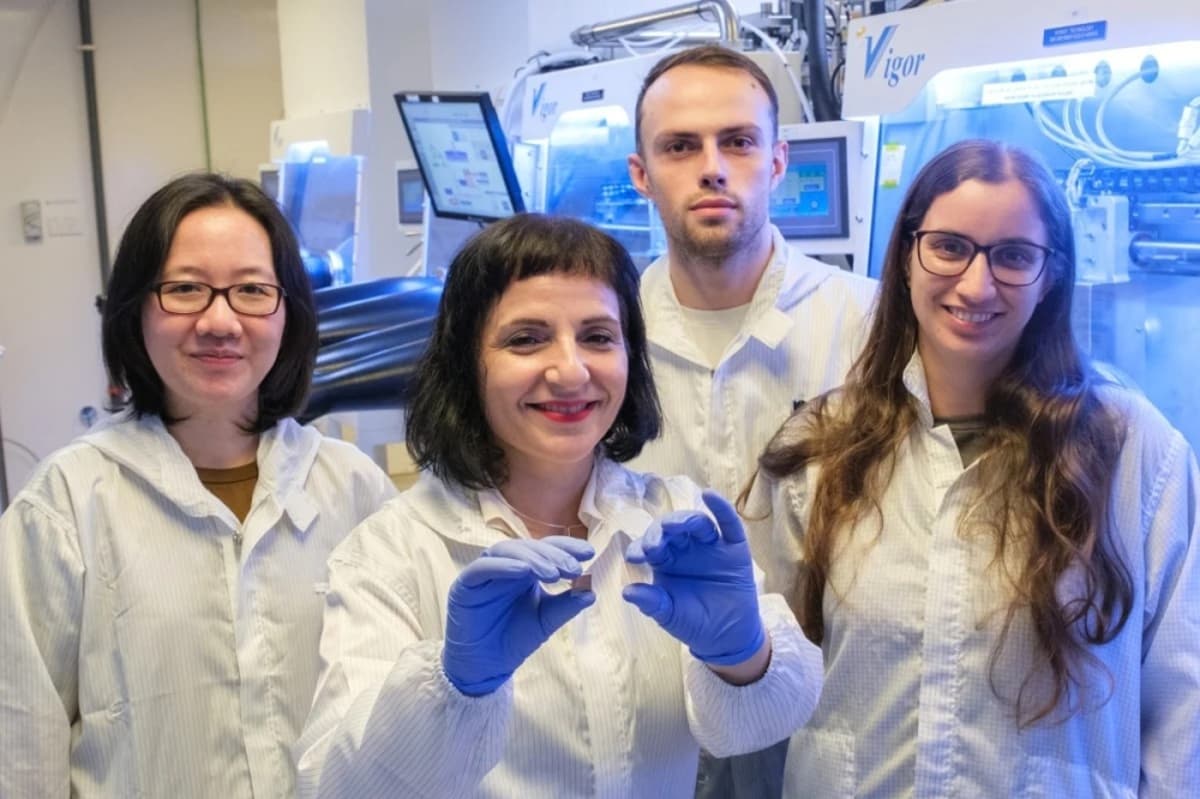
Singapore Team Makes Ultrathin Perovskite Solar Cells
Why It Matters
The breakthrough could turn building glass into active energy generators, addressing the built environment’s 40% share of global electricity demand and opening a new market for lightweight, transparent photovoltaics.
Key Takeaways
- •NTU team creates perovskite cells 50× thinner than standard
- •60 nm opaque cells reach 12% efficiency, 7.6% semi‑transparent
- •Thermal evaporation enables solvent‑free, uniform large‑area films
- •Cells transmit 41% visible light, suitable for power‑generating windows
- •Researchers target scale‑up and longer‑term stability for commercial use
Pulse Analysis
The ultrathin perovskite breakthrough arrives at a pivotal moment for thin‑film photovoltaics. Traditional perovskite devices rely on solution‑based coating, which can introduce solvent residues and limit uniformity over large substrates. NTU’s vacuum‑based thermal evaporation sidesteps these issues, delivering nanometer‑scale layers with precise thickness control. By achieving 12% power conversion in a 60 nm opaque film and 7.6% in a semi‑transparent version, the research sets a new benchmark for efficiency‑to‑thickness ratios, suggesting that perovskite technology can compete with silicon in applications where weight and form factor matter.
Building‑integrated photovoltaics (BIPV) stand to benefit most from this development. The semi‑transparent cells transmit 41% of visible light while generating electricity, enabling windows and façades that maintain aesthetic neutrality. Given that the built environment consumes roughly 40% of global energy, converting glass surfaces into power‑producing assets could shave billions of kilowatt‑hours off annual demand. Early modeling indicates that a glass‑fronted office tower could generate several hundred megawatt‑hours per year—enough to power about 100 typical Singaporean HDB flats—illustrating the scalability potential of the technology.
Commercialization, however, hinges on three challenges: long‑term stability, large‑area uniformity, and cost‑effective manufacturing. Perovskite materials are notoriously sensitive to moisture and UV exposure, so durability testing under real‑world conditions will be decisive. The vacuum evaporation process, while solvent‑free, must be adapted to roll‑to‑roll production lines to achieve economies of scale. If NTU and its industry partners can resolve these hurdles, ultrathin perovskite panels could complement or even replace conventional silicon modules in niche markets such as smart windows, lightweight electronics, and automotive glazing, reshaping the renewable‑energy landscape.
Singapore team makes ultrathin perovskite solar cells
Comments
Want to join the conversation?
Loading comments...