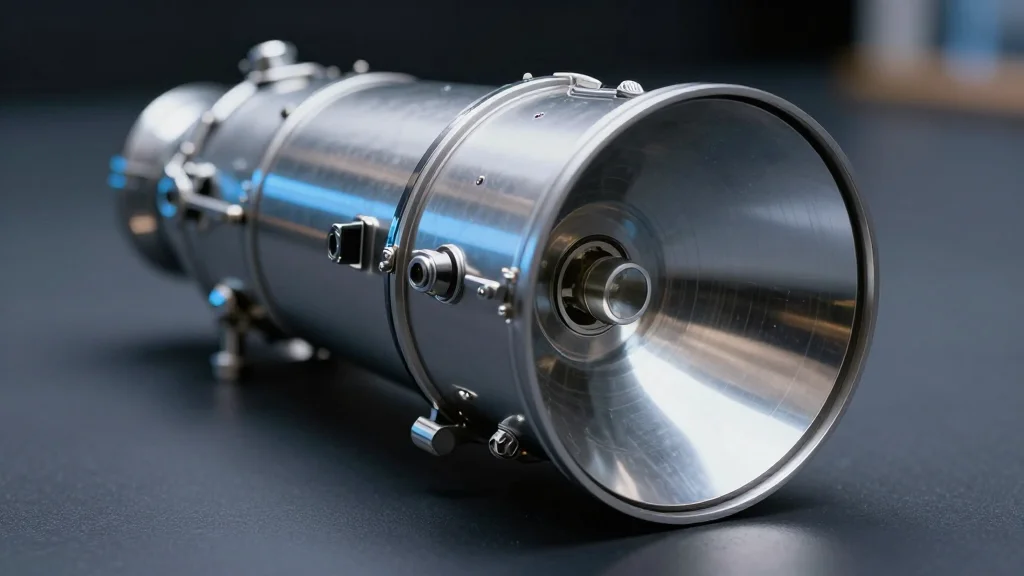
Single-Ion Traps and Cubic Cavities for Field-Deployable Laser-Cooled Optical Atomic Clocks
Why It Matters
A field‑deployable optical clock provides a resilient, high‑precision timing source that can operate independently of GNSS, strengthening national security, critical infrastructure and commercial logistics.
Key Takeaways
- •Compact strontium ion optical clock achieves sub‑10⁻¹⁸ accuracy
- •Redesigned ion trap reduces size, weight, power by 40%
- •Dual‑axis cubic cavity stabilizes multiple lasers in a single package
- •Finite element analysis predicts thermal drift below 1 µK per hour
- •Extended holdover enables autonomous timing for space and terrestrial missions
Pulse Analysis
The growing reliance on GNSS for navigation, finance and critical infrastructure has exposed a systemic weakness: signals can be jammed, spoofed, or disrupted by solar storms. As nations seek resilient timing sources, optical atomic clocks have emerged as a compelling alternative. By interrogating optical transitions in trapped ions, these clocks achieve fractional uncertainties an order of magnitude better than the best commercial microwave standards, translating into nanosecond‑level timing accuracy over days. This performance gap promises to safeguard positioning and synchronization services even when satellite constellations are compromised.
The research team’s latest prototype tackles the classic size‑weight‑power barrier that has limited optical clocks to laboratory benches. A compact strontium‑ion trap, reshaped through finite‑element modeling, cuts thermal gradients and reduces power draw by roughly 40 % while preserving sub‑10⁻¹⁸ frequency stability. Complementing the trap is a dual‑axis cubic optical cavity that locks the cooling, repumping and clock lasers within a single, monolithic block. The cavity’s geometry minimizes vibration sensitivity and enables multi‑wavelength operation without additional bulk optics, delivering a thermal drift under 1 µK per hour—critical for long‑term holdover.
These engineering advances position field‑deployable optical clocks as viable replacements for legacy rubidium or cesium standards in both space‑borne and ground‑based platforms. Defense agencies, autonomous vehicle networks, and financial exchanges stand to benefit from autonomous timing that can operate independently of GNSS for weeks. While commercialization will require ruggedization and cost reductions, the demonstrated SWaP improvements suggest a realistic path to volume production within the next five years. Ultimately, the convergence of high‑precision ion trapping and compact cavity design could redefine the global timing architecture, reinforcing security and operational continuity across sectors.
Single-ion traps and cubic cavities for field-deployable laser-cooled optical atomic clocks
Comments
Want to join the conversation?
Loading comments...