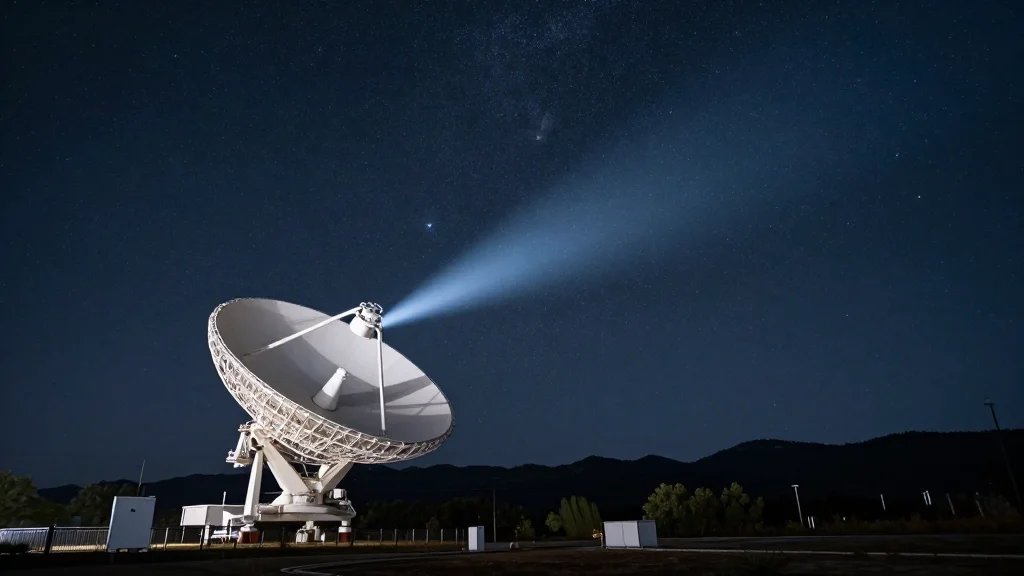
Six New Isolated Millisecond Pulsars Discovered with FAST
Why It Matters
The expanded pulsar census refines models of neutron‑star formation and globular‑cluster dynamics, while the stacking approach proves that archival data can still yield high‑impact discoveries.
Key Takeaways
- •Stacking technique revealed six faint isolated millisecond pulsars.
- •Pulsar counts in NGC 6517 and M15 grew 27% and 18%.
- •Spin periods range from 3.68 ms to 9.29 ms.
- •FAST GC‑FANS survey now exceeds 60 pulsars in 16 clusters.
Pulse Analysis
Millisecond pulsars (MSPs) are among the fastest rotating neutron stars, serving as precise cosmic clocks that illuminate the extreme physics of dense matter and magnetic fields. Their prevalence in globular clusters—dense stellar environments where close encounters are common—offers a unique laboratory for studying stellar evolution and dynamical interactions. The Five‑hundred‑meter Aperture Spherical radio Telescope (FAST) provides unparalleled sensitivity, especially for faint, high‑frequency signals that elude smaller dishes, making it an ideal instrument for deep pulsar hunts within these crowded systems.
The recent discovery of six isolated MSPs in NGC 6517 and M15 showcases the power of data‑stacking methods. By co‑adding power spectra from dozens of observations spanning several years, researchers amplified weak periodic signatures that single‑epoch searches missed. This technique not only boosted the signal‑to‑noise ratio but also demonstrated that existing archives can be re‑mined for new science, effectively extending the operational lifespan of costly telescope campaigns. The added pulsars increase the known populations in the two clusters by 27% and 18%, respectively, providing fresh constraints on the clusters' mass distribution, core collapse dynamics, and the binary‑disruption pathways that produce isolated MSPs.
Looking ahead, the success of FAST's GC‑FANS survey signals a broader shift toward leveraging archival datasets across radio astronomy. As more facilities adopt high‑resolution, long‑duration monitoring, stacking and other advanced signal‑processing tools will become standard for uncovering faint astrophysical phenomena. For the scientific community, these findings underscore the importance of open data policies and collaborative analysis pipelines, ensuring that the next generation of discoveries may emerge from yesterday’s observations as readily as from tomorrow’s telescopes.
Six new isolated millisecond pulsars discovered with FAST
Comments
Want to join the conversation?
Loading comments...