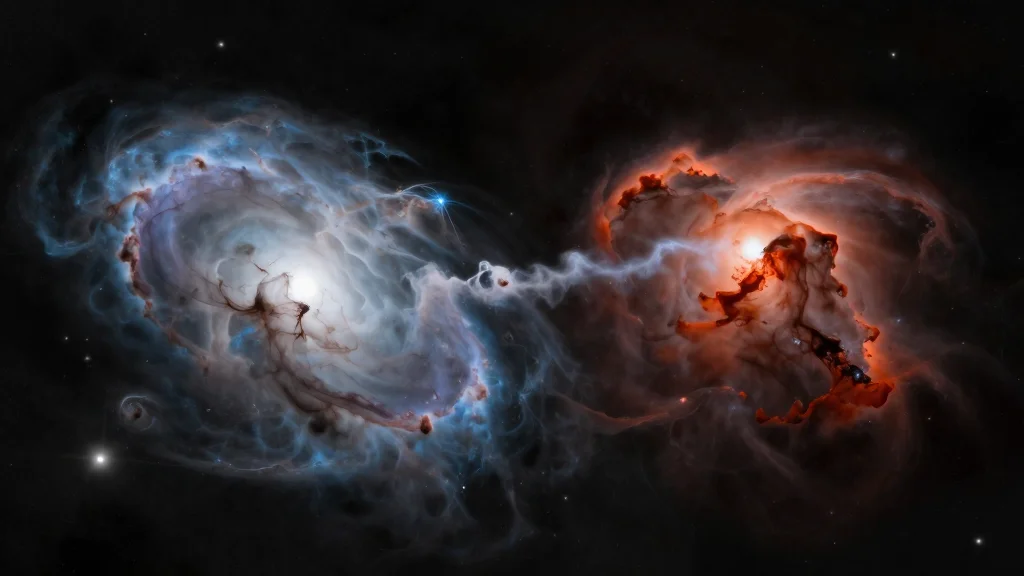
Small Magellanic Cloud Is Being Pulled Apart, Reshaping How Astronomers Read Its Past
Why It Matters
The discovery forces a revision of dynamical models for satellite dwarf galaxies, affecting how astronomers reconstruct the Milky Way’s accretion history and predict future interactions. It also highlights the need for tidal‑force‑aware simulations in galaxy‑evolution research.
Key Takeaways
- •VMC survey maps SMC stellar motions over 11‑year baseline.
- •Stars show outward radial speeds ~17 km/s, indicating tidal expansion.
- •No coherent rotation detected; tidal forces dominate dynamics.
- •Younger stars exhibit stronger outward motion than older red giants.
- •Findings challenge rotating‑disk models for dwarf satellite galaxies.
Pulse Analysis
The Small Magellanic Cloud, a nearby dwarf satellite of the Milky Way, has become a natural laboratory for studying galactic tides. By leveraging near‑infrared imaging from the VISTA telescope, the VMC project extended its observational baseline to more than a decade, allowing astronomers to measure proper motions with three‑fold higher precision than earlier ground‑based efforts. This level of detail uncovers subtle kinematic patterns that were previously masked, offering a clearer view of how gravitational interactions sculpt dwarf galaxies over billions of years.
Tidal forces from the Large Magellanic Cloud are now shown to dominate the SMC’s internal dynamics. Rather than rotating as a coherent disk, the SMC’s stars are moving radially outward at roughly 17 km s⁻¹, a rate that can shift stellar positions by thousands of light‑years within a few hundred million years. The differential response among stellar age groups—young stars expanding more vigorously than ancient red giants—suggests that each generation records a distinct phase of the inter‑galactic encounter. These findings compel a reassessment of standard rotating‑disk assumptions used in dwarf‑galaxy simulations, urging modelers to incorporate time‑varying tidal fields.
Beyond the Magellanic system, the study provides a template for interpreting the disrupted structures of other satellite galaxies orbiting massive hosts. Accurate kinematic maps can refine estimates of dark‑matter halo shapes and improve predictions of future merger events. As next‑generation facilities like the Vera C. Rubin Observatory come online, the methodology demonstrated by the VMC team will be essential for translating vast astrometric datasets into actionable insights about galaxy formation and evolution.
Small Magellanic Cloud is being pulled apart, reshaping how astronomers read its past
Comments
Want to join the conversation?
Loading comments...