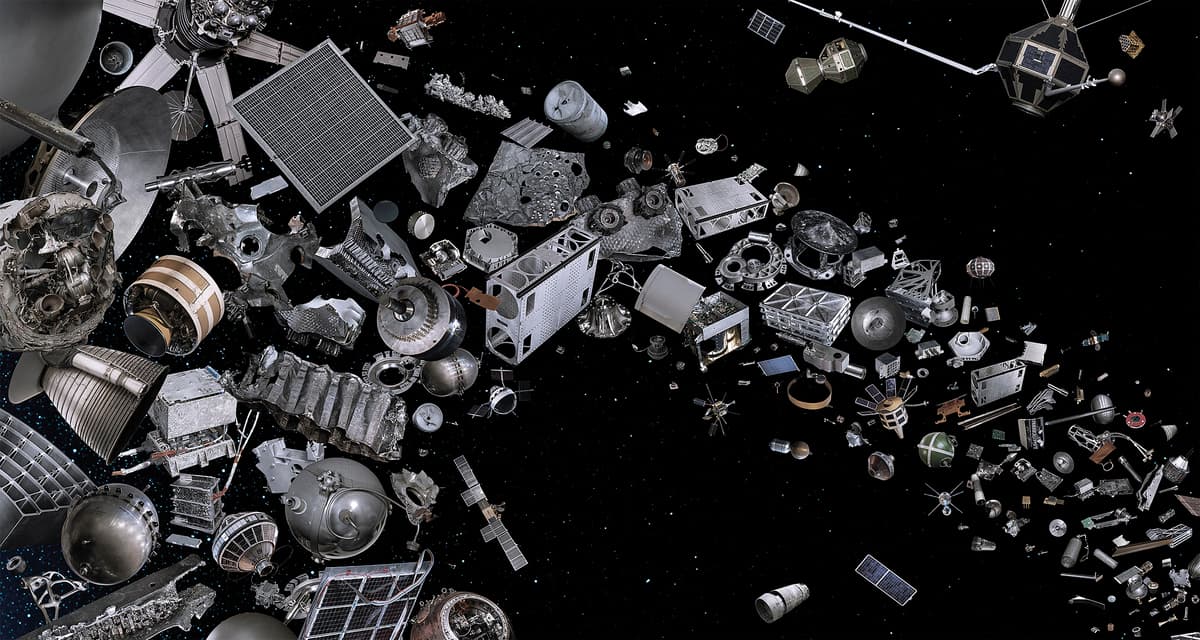
Solar Activity Determines How Fast Space Junk Falls to Earth
Why It Matters
Understanding the solar‑driven decay window lets satellite owners and debris‑removal planners prioritize re‑boosts and capture missions, protecting assets and reducing Kessler‑syndrome risk. It also improves cost forecasting for fuel and mission lifespan as solar cycles evolve.
Key Takeaways
- •Decay rate spikes when sunspot activity exceeds ~70% of cycle max
- •Peak solar cycles double debris descent to ~1.9 ft/hour
- •Operators must schedule more frequent re‑boosts during solar maximum
- •Debris‑removal priority shifts as drag‑induced decay accelerates
Pulse Analysis
The Sun’s 11‑year cycle is more than a solar‑physics curiosity; it directly reshapes the low‑Earth‑orbit environment. As sunspot numbers climb, ultraviolet and extreme‑ultraviolet radiation heat the thermosphere, inflating atmospheric density at altitudes where most satellites and debris travel. This extra drag acts like a brake, pulling objects down faster. The recent Frontiers in Astronomy and Space Sciences paper leverages three full cycles of Space‑Track data to quantify that effect, pinpointing the exact activity level where decay rates jump.
By following 17 legacy debris items launched in the 1960s, the authors observed a consistent pattern: a gentle descent during solar minimum, a steep linear drop once sunspot counts reach roughly two‑thirds of their peak, and a return to slower decay as the cycle wanes. The most vigorous cycle (Solar Cycle 22) produced an average peak decay of 1.94 feet per hour, while the quieter Cycle 24 saw less than half that rate. These numbers, though seemingly modest, translate into hundreds of meters of altitude loss over months, dramatically altering conjunction probabilities for nearby operational satellites.
For the commercial and defense space sectors, the practical upshot is clear. Operators can now schedule orbit‑maintenance burns with a data‑driven timeline, allocating extra propellant ahead of predicted drag spikes. Debris‑removal missions gain a prioritization metric: objects that would otherwise be low‑risk at solar minimum become urgent targets as the Sun approaches maximum. Integrating solar‑activity forecasts into collision‑avoidance algorithms therefore enhances both safety and cost efficiency, a crucial advantage as low‑Earth‑orbit traffic continues to surge.
Solar activity determines how fast space junk falls to Earth
Comments
Want to join the conversation?
Loading comments...