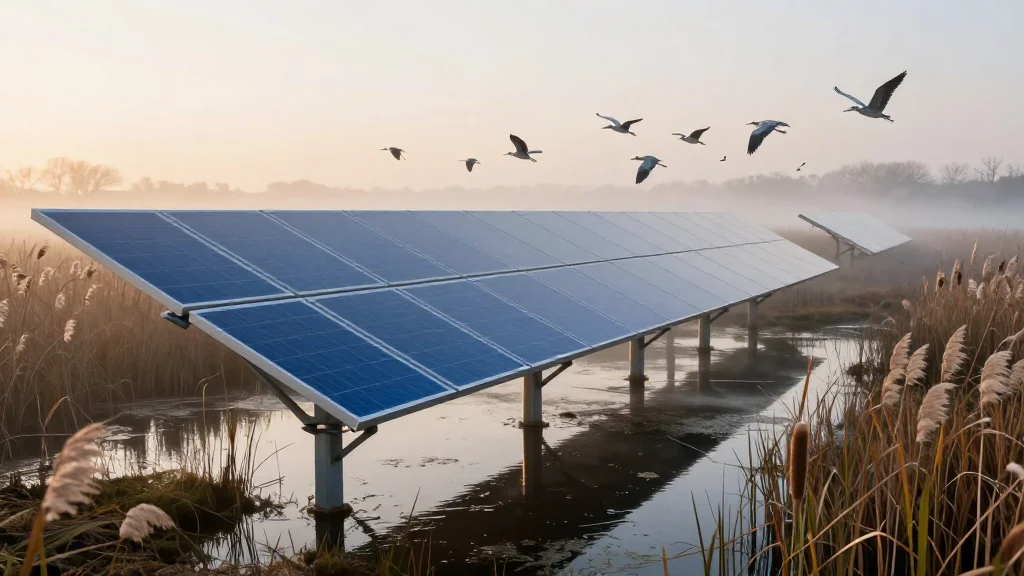
Solar Panels on Rewetted Peatland Could Be a Climate and Nature Win–Win
Why It Matters
The study demonstrates a scalable land‑use approach that simultaneously advances climate mitigation, biodiversity conservation, and renewable‑energy production, informing policy on peatland restoration and clean‑energy deployment.
Key Takeaways
- •Solar panels on rewetted peatland host threatened bird species.
- •Renewable energy generation coexists with carbon‑rich peatland restoration.
- •German subsidy scheme incentivizes landowners to combine rewetting and solar.
- •Study limited to one site; broader research needed for generalization.
Pulse Analysis
Peatlands store more carbon per hectare than most forests, yet decades of drainage for agriculture have turned them into major greenhouse‑gas emitters. Restoring these wetlands—known as rewetting—captures carbon and revives biodiversity, but landowners often lack financial incentives to abandon productive use. Germany’s recent subsidy program bridges that gap by paying farmers to install photovoltaic arrays while simultaneously raising water tables. This hybrid model promises to turn a climate liability into a dual‑purpose asset, delivering clean electricity and carbon sequestration on the same parcel of land.
The University of Greifswald team surveyed a solar park on a rewetted peatland in northern Germany, comparing its avian community to adjacent drained fields used for livestock feed. Using autonomous audio recorders and machine‑learning classifiers, researchers documented an unusually rich mix of wetland, agricultural and woodland birds, including the endangered meadow pipit and reed bunting. The panels themselves provided perches and hunting platforms, illustrating how infrastructure can be repurposed for wildlife. These results suggest that, at least in the short term, renewable‑energy installations can enhance rather than suppress biodiversity when paired with proper habitat restoration.
While the findings are encouraging, the study represents only one of roughly five such sites worldwide, so extrapolation must be cautious. Policymakers could leverage this evidence to expand incentive schemes, targeting peatlands with low restoration potential for solar integration while preserving high‑value, intact bogs. Ongoing monitoring of bats, insects and long‑term carbon fluxes will clarify the ecological trade‑offs. If replicated, the model could be exported to the UK, the Netherlands and other peat‑rich regions, offering a pragmatic pathway to meet renewable‑energy targets without sacrificing nature.
Solar panels on rewetted peatland could be a climate and nature win–win
Comments
Want to join the conversation?
Loading comments...