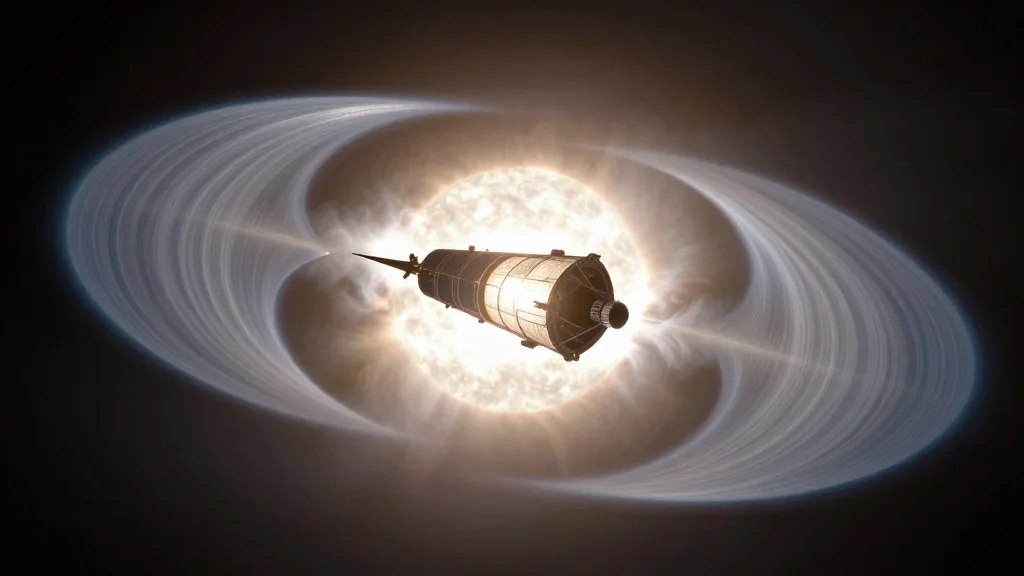
Solar Radio Bursts Reveal Hidden Magnetic Switchbacks Near the Sun, Parker Solar Probe Data Suggest
Why It Matters
Understanding magnetic switchbacks improves models of solar wind acceleration and space‑weather forecasting, offering a new diagnostic tool for heliophysics research.
Key Takeaways
- •Half of observed type III bursts show magnetic switchback signatures
- •Average deviation displacement: 1.1 solar radii
- •Magnetic field deviations up to 88° inferred
- •Density changes alone cannot explain drift variations
- •PSP/FIELDS frequencies enable remote inner‑heliosphere probing
Pulse Analysis
Type III radio bursts, generated by fast electrons streaming along open magnetic field lines, have long served as a window into the Sun’s corona and solar wind. The Parker Solar Probe’s FIELDS instrument now captures these bursts at kilometer wavelengths, allowing scientists to translate peak frequencies into precise radial distances. This capability transforms a classic solar‑radio phenomenon into a high‑resolution probe of the magnetic topology that electrons traverse, complementing in‑situ measurements and advancing our grasp of heliospheric dynamics.
Analyzing 24 interplanetary type III events over a single week, the research team found that 50 % displayed frequency‑drift anomalies exceeding the instrument’s 0.57‑solar‑radius noise threshold. The anomalies correspond to spatial displacements averaging 1.1 solar radii and imply magnetic‑field bends ranging from 23 ° to 88 ° across 1.8‑6.4 solar radii. While density fluctuations of 10‑30 % could produce similar signatures, the required magnitude would be implausibly high, leading the authors to favor magnetic switchbacks as the primary cause. Four bursts exhibited the full suite of simulated switchback features, reinforcing the magnetic interpretation.
The discovery that type III burst morphology encodes magnetic‑field deviations reshapes how researchers monitor the inner heliosphere. By providing a remote, continuous diagnostic of switchbacks—structures linked to solar‑wind acceleration—these findings can refine predictive models of space weather that affect satellite operations and power grids on Earth. Future missions equipped with broadband radio receivers and coordinated PSP observations will likely expand this technique, turning solar radio astronomy into a frontline tool for real‑time heliophysics surveillance.
Solar radio bursts reveal hidden magnetic switchbacks near the sun, Parker Solar Probe data suggest
Comments
Want to join the conversation?
Loading comments...