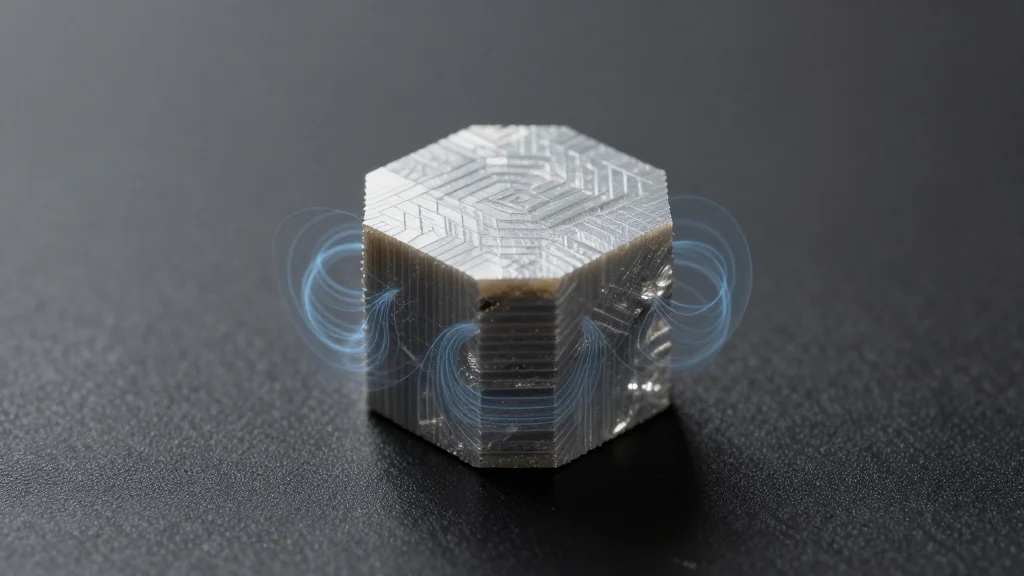
Soundwaves Settle Debate About Elusive Quantum Particle
Why It Matters
The result overturns a high‑profile claim of Majorana quasiparticles, reshaping expectations for topological qubits, and introduces Hall viscosity as a powerful diagnostic for hidden orders in quantum materials.
Key Takeaways
- •Cornell used ultrasonic phonon measurements to reveal Hall viscosity.
- •Chiral phonons, not Majorana fermions, cause thermal Hall effect in RuCl3.
- •Acoustic Faraday effect shows sound wave polarization rotates under magnetic field.
- •Technique offers new probe for exotic quantum states in insulators.
- •Spin‑orbit coupling enables phonons to sense magnetic fields.
Pulse Analysis
The hunt for Majorana fermions has driven much of the recent excitement in quantum‑materials research, because a pair of localized Majoranas could encode a topologically protected qubit. In 2018 a Japanese team reported a quantized thermal Hall conductivity in the insulating magnet α‑RuCl₃, interpreting the signal as evidence of itinerant Majoranas in a quantum spin‑liquid state. The claim sparked a wave of follow‑up experiments, but reproducibility proved elusive, and skeptics argued that magnetic impurities or sample inhomogeneities might mimic the Hall response. The debate highlighted the difficulty of inferring microscopic excitations from bulk heat‑transport measurements.
Cornell physicists sidestepped the heat‑flow ambiguity by listening to the lattice itself. Using high‑frequency ultrasonic pulses they tracked phonon trajectories while applying a magnetic field, observing a cork‑screw‑like twist known as the acoustic Faraday effect. This behavior directly revealed a non‑zero Hall viscosity—a form of ‘gravitational’ Hall response that rotates phonon polarization and, consequently, the heat current. The result shows that chiral phonons, not Majorana quasiparticles, generate the thermal Hall signal in RuCl₃, and it demonstrates that spin‑orbit coupling can endow neutral lattice vibrations with magnetic chirality.
The discovery opens a new experimental window on hidden orders in insulating magnets. Hall viscosity can now be measured as a diagnostic for exotic phases such as Kitaev spin liquids, fractionalized excitations, or topological magnons, without relying on indirect thermal measurements. Moreover, the ultrasonic technique is broadly applicable to other layered van‑der‑Waals compounds where spin‑orbit interactions are strong. As the community refines these tools, the path toward fault‑tolerant quantum computing may shift from chasing elusive Majoranas to engineering controllable phononic and viscoelastic responses that can be harnessed for quantum information processing.
Soundwaves settle debate about elusive quantum particle
Comments
Want to join the conversation?
Loading comments...