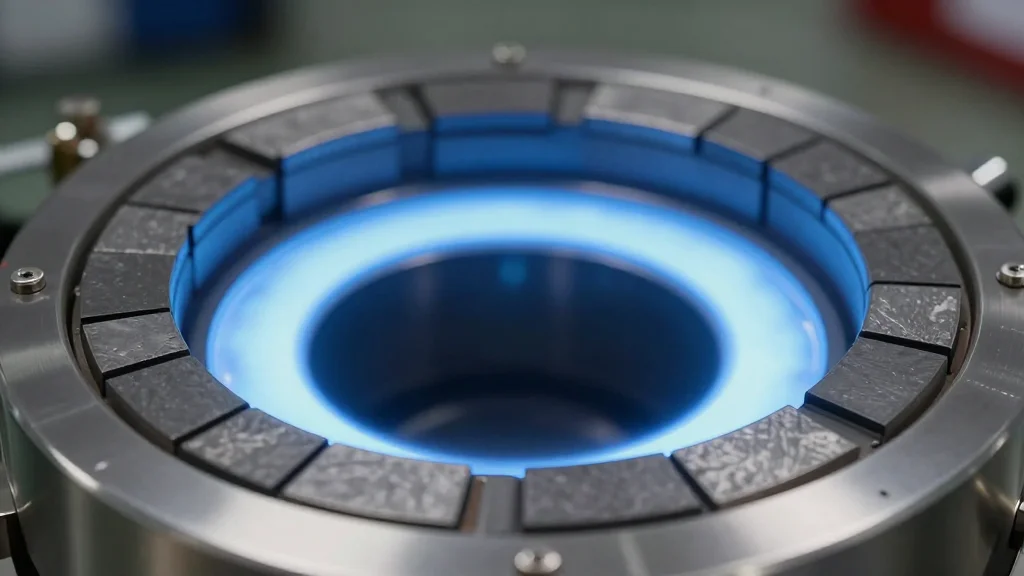
South Korea's KSTAR Tokamak Holds Plasma for 102 Seconds, 48 at 100 Million°C

Why It Matters
The ability to hold plasma at fusion‑relevant temperatures for over a minute demonstrates that the technical barriers to sustained fusion are surmountable, moving the field from short‑burst experiments toward continuous power generation. Achieving the 300‑second target would bring reactors within striking distance of net‑energy gain, a prerequisite for commercial deployment. Moreover, the tungsten divertor breakthrough addresses one of the most persistent challenges—managing the extreme heat flux that erodes reactor walls—thereby extending component lifetimes and reducing maintenance costs. For policymakers and investors, KSTAR’s progress signals that fusion is transitioning from a long‑term research endeavor to a near‑term commercial opportunity. Countries that invest in advanced materials and tokamak engineering now could capture a share of the future clean‑energy market, potentially displacing fossil fuels and accelerating decarbonization efforts worldwide.
Key Takeaways
- •KSTAR sustained H‑mode plasma for 102 seconds, a new record for the reactor.
- •Ion temperature reached 100 million °C and was held for 48 seconds.
- •New tungsten divertor technology enabled longer, more stable pulses.
- •KFE aims for 300‑second plasma runs to approach net‑energy gain.
- •Result positions South Korea alongside ITER and other leading fusion programs.
Pulse Analysis
KSTAR’s latest run underscores a shift in fusion strategy: rather than waiting for the massive ITER project to demonstrate net gain, national programs are leveraging incremental hardware upgrades to push performance boundaries. The tungsten divertor is a case study in how material science can unlock longer pulse durations without overhauling the entire reactor design. This approach reduces risk and capital outlay, allowing countries like South Korea to claim leadership in specific technical niches.
Historically, fusion research has been dominated by the pursuit of ever‑larger devices, with the assumption that size alone would solve confinement challenges. KSTAR’s achievement suggests a complementary path—optimizing existing platforms through targeted upgrades. If the 200‑second and eventually 300‑second targets are met, the data could inform the design of DEMO reactors, which aim to produce electricity for the grid. The ripple effect may also accelerate private‑sector initiatives such as Commonwealth Fusion Systems and Tokamak Energy, which are betting on compact, high‑field machines.
Looking forward, the key question is whether the lessons from KSTAR’s tungsten divertor can be scaled to the megawatt‑class heat loads expected in commercial reactors. Successful scaling would lower the cost of divertor replacement, a major expense in current tokamak operations. International collaboration on divertor testing, combined with shared simulation tools, could standardize best practices, hastening the arrival of practical fusion power. In the meantime, KSTAR’s record serves as a tangible benchmark for the global community, proving that each additional second of plasma confinement brings the promise of clean, limitless energy closer to reality.
South Korea's KSTAR Tokamak Holds Plasma for 102 Seconds, 48 at 100 Million°C
Comments
Want to join the conversation?
Loading comments...