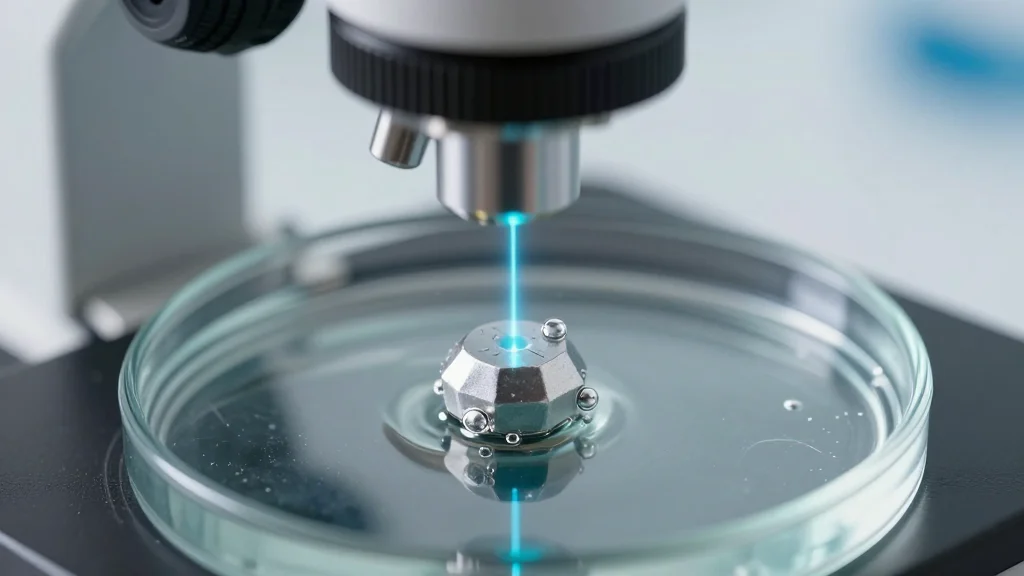
Spatial Imaging of Water Oxidation on Single-Particle Catalysts
Why It Matters
Understanding where water oxidation occurs at the nanoscale guides the engineering of more efficient, lower‑cost electrocatalysts, accelerating the transition to renewable hydrogen production.
Key Takeaways
- •Operando Raman‑SECM maps pinpoint active edge facets on single particles
- •Local turnover frequency varies >10× between facets and bulk
- •Catalyst design can prioritize high‑activity corners to boost overall OER
- •Spatial imaging links surface chemistry to kinetic performance
- •Single‑particle analysis reveals heterogeneity hidden in bulk measurements
Pulse Analysis
The oxygen evolution reaction (OER) remains the bottleneck in electro‑ and photo‑water splitting, consuming most of the energy input. Traditional catalyst assessments average performance over ensembles, masking the intrinsic heterogeneity of individual particles. The new spatial imaging approach leverages operando Raman spectroscopy alongside scanning electrochemical microscopy (SECM) to capture real‑time activity maps on a particle‑by‑particle basis. By resolving the distribution of reactive sites, researchers can directly observe how crystallographic facets, edges, and defects influence local reaction kinetics, offering a granular view that bulk techniques simply cannot provide.
Beyond mere visualization, the study quantifies turnover frequencies at specific surface locations, revealing that edge and corner facets can be an order of magnitude more active than flat basal planes. This facet‑dependent behavior aligns with theoretical predictions that under‑coordinated atoms lower the activation barrier for O–O bond formation. Consequently, catalyst synthesis strategies can shift focus toward engineering nanostructures that expose these high‑energy sites—such as nanorods, nanoplates, or hierarchical assemblies—rather than merely increasing surface area. The findings also underscore the importance of surface treatments that preserve or enhance active edge chemistry while suppressing passivation on bulk regions.
For the broader renewable‑energy market, these insights translate into tangible performance gains. Catalysts optimized for facet‑specific activity can achieve higher current densities at lower overpotentials, reducing the electricity cost of hydrogen generation. Moreover, the spatial imaging methodology is adaptable to a range of material systems, from transition‑metal oxides to emerging perovskite photoanodes, paving the way for accelerated discovery and scaling of next‑generation water‑splitting technologies.
Spatial imaging of water oxidation on single-particle catalysts
Comments
Want to join the conversation?
Loading comments...