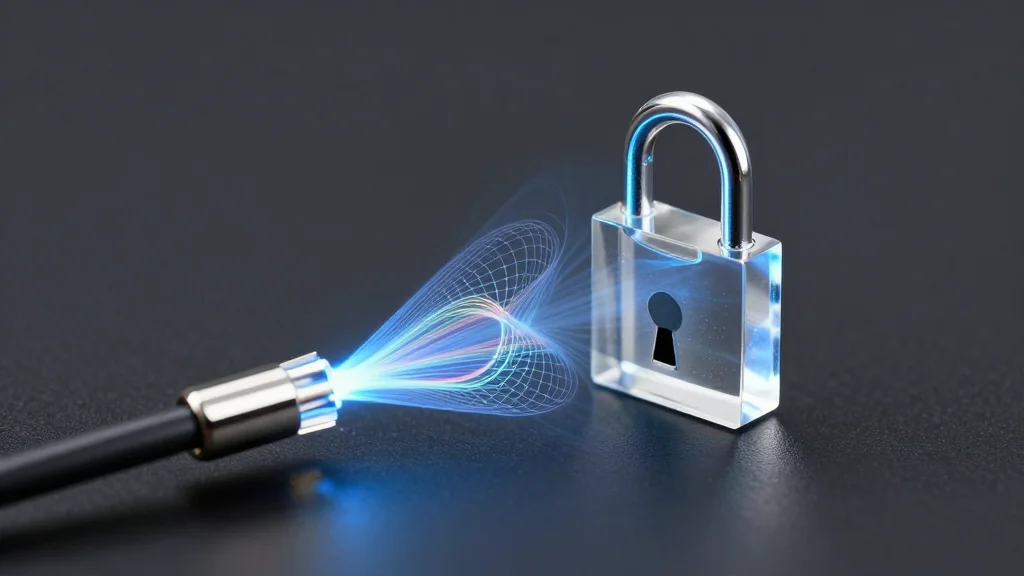
Spatiotemporal Light Pulses Could Secure Optical Communication by Masking Data
Why It Matters
By masking data at the physical layer, the technique offers a complementary defense against quantum‑era threats, potentially reshaping secure free‑space and fiber optics networks. Its success could reduce reliance on computationally intensive cryptography for high‑speed links.
Key Takeaways
- •Spatiotemporal optical vortices hide data in light’s structure
- •System appears uniform to eavesdroppers, revealing no intensity changes
- •Shared key and decoy signals enable synchronized decoding
- •Simulations show resilience to noise and high data capacity
- •Method remains theoretical; real-world testing pending
Pulse Analysis
The race to protect data against quantum computers has spurred interest in physical‑layer security, where the signal itself becomes the first line of defense. Traditional optical links rely on mathematical encryption that could be cracked once large‑scale quantum processors mature. By encoding information in the topological charge and temporal profile of a pulse, spatiotemporal optical vortices create a carrier that looks like a bland, uniform beam to any standard photodetector, effectively hiding the payload before it even reaches the decryption stage.
Beyond obscuring the data, the Ben‑Gurion proposal integrates a coordinated key‑distribution protocol. The transmitter (Alice) maps bits to vortex charges using a secure classical channel, while the receiver (Bob) synchronizes a reference laser to decode the interferometric pattern captured on a CCD. This dual‑layer approach—physical masking plus algorithmic decoy placement—boosts security without sacrificing bandwidth. Simulations indicate that the method tolerates atmospheric turbulence and detector noise, suggesting suitability for free‑space links such as satellite‑to‑ground communications, where line‑of‑sight integrity is critical.
Nevertheless, the technology is still confined to theory and lab‑scale modeling. Real‑world deployment will demand robust adaptive optics, precise timing control, and scalable hardware for generating and detecting complex vortex structures. If these engineering hurdles are overcome, spatiotemporal vortex communication could complement post‑quantum cryptography, offering a hybrid safeguard for high‑value data streams across both terrestrial and space‑based networks. The research thus marks a promising step toward future‑proof optical security, aligning with industry moves toward quantum‑resilient infrastructure.
Spatiotemporal light pulses could secure optical communication by masking data
Comments
Want to join the conversation?
Loading comments...