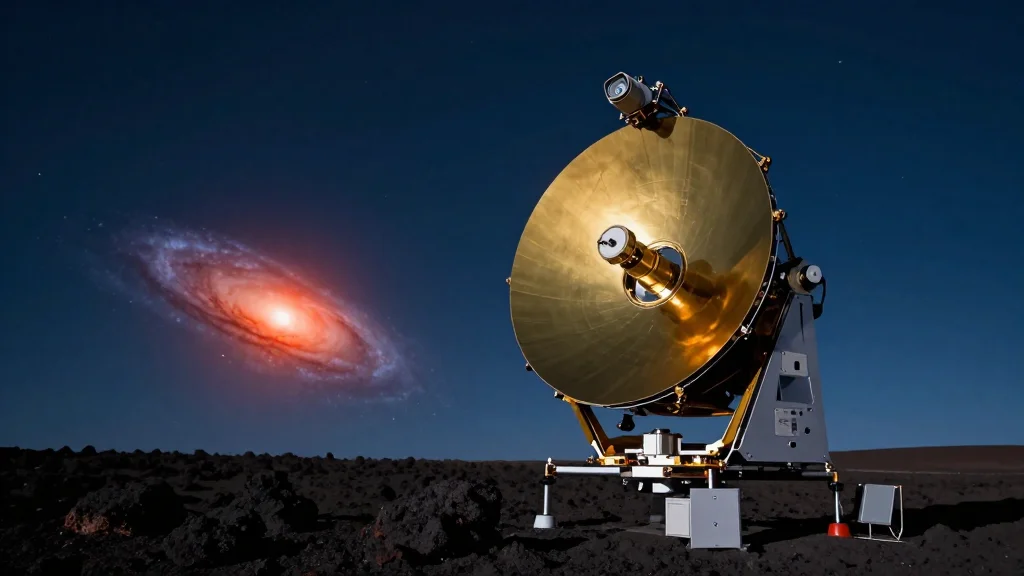
Spiral Galaxy's Brilliant Heart Shines Bright in a New Picture From NASA's Webb Telescope
Companies Mentioned

Why It Matters
The image provides unprecedented detail of an active galactic nucleus, helping astronomers refine models of black‑hole feeding and galaxy evolution, while demonstrating JWST’s power for future extragalactic research.
Key Takeaways
- •Webb captures Messier 77’s core in unprecedented mid‑infrared detail.
- •Galaxy lies 45 million light‑years away in Cetus constellation.
- •Central black hole weighs ~8 million solar masses, driving active nucleus.
- •Hot gas orbiting black hole emits extreme radiation detectable by Webb.
- •Image showcases JWST’s ability to study nearby active galaxies.
Pulse Analysis
The James Webb Space Telescope, launched in 2021, continues to redefine observational astronomy with its suite of infrared instruments. By targeting Messier 77, one of the closest barred spiral galaxies, JWST leverages its mid‑infrared camera to pierce dust clouds that obscure visible light, revealing the galaxy’s luminous heart in crisp detail. This capability not only produces spectacular imagery for public outreach but also supplies scientists with high‑resolution spectra essential for probing the physical conditions of the interstellar medium surrounding active nuclei.
At the core of Messier 77 lies a supermassive black hole estimated at eight million solar masses. As surrounding gas accelerates into a tight orbit, it heats to millions of degrees, emitting radiation across the electromagnetic spectrum. Webb’s detection of this extreme emission in the infrared band offers a fresh window into the mechanics of active galactic nuclei (AGN), allowing researchers to map gas flows, measure outflow velocities, and assess how energy feedback influences star formation in the host galaxy. These insights are critical for refining theoretical models that link black‑hole growth to galaxy evolution over cosmic time.
Beyond the immediate scientific payoff, the new image reinforces JWST’s role as a workhorse for extragalactic surveys. Its ability to resolve fine structures in nearby AGN paves the way for comparative studies across a range of galaxy types, from quiescent spirals to luminous quasars. As the telescope continues its mission, astronomers anticipate a cascade of discoveries that will deepen our understanding of the universe’s most energetic phenomena, while captivating the public with visuals that bridge complex astrophysics and accessible storytelling.
Spiral galaxy's brilliant heart shines bright in a new picture from NASA's Webb telescope
Comments
Want to join the conversation?
Loading comments...