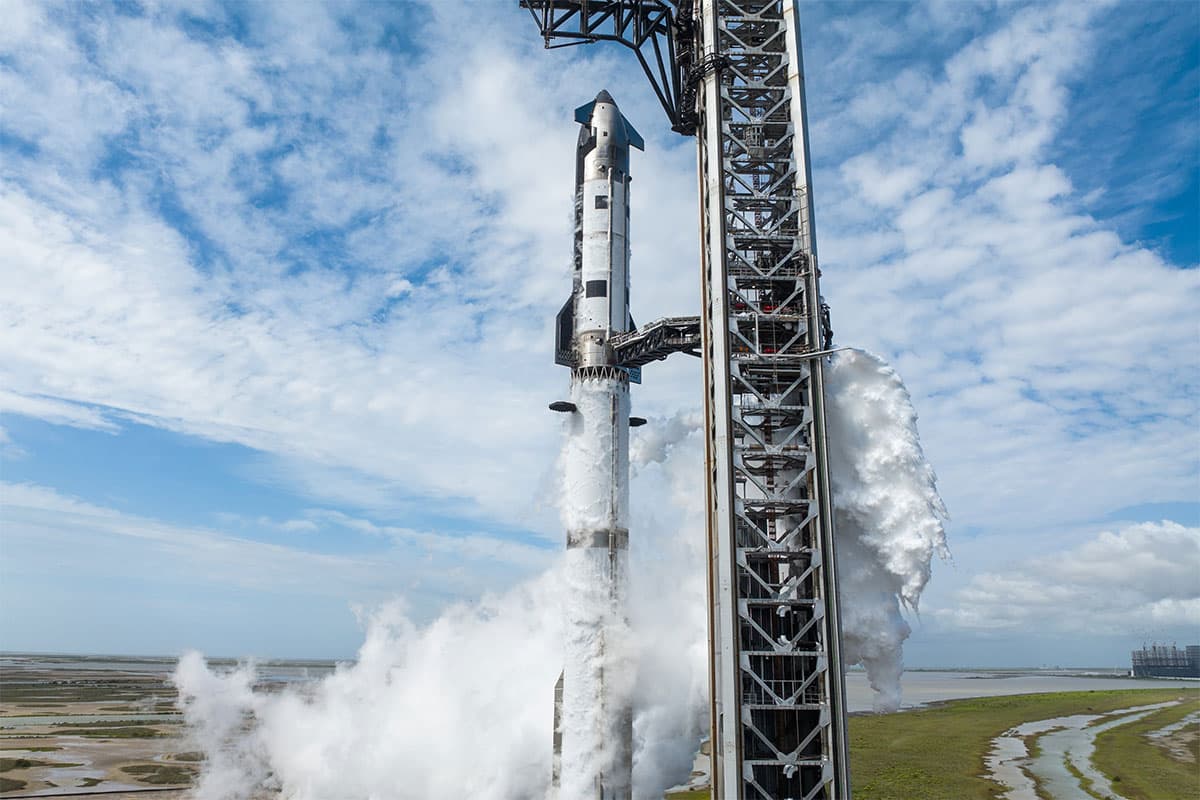
Starship V3 Booster Roars to Life in Major SpaceX Test
Companies Mentioned
Why It Matters
The successful static fire clears a critical technical hurdle, accelerating SpaceX’s timeline for an orbital Starship launch and strengthening its position in the emerging deep‑space launch market. It also signals progress toward NASA’s Artemis lunar contracts and commercial Mars ambitions.
Key Takeaways
- •SpaceX ignited all 33 Super Heavy engines on Texas launch pad
- •Test validates propulsion system for Starship V3 configuration
- •Booster completed a six‑second static fire without anomalies
- •Data will shape timeline for an orbital flight later this year
- •Success reinforces SpaceX's dominance in heavy‑lift launch market
Pulse Analysis
SpaceX’s Starship program entered a new phase in early May when the company executed a full‑duration static fire of the V3‑version Super Heavy booster at its Boca Chica facility. Unlike earlier short‑burn tests, this trial lit all 33 Raptor engines simultaneously for roughly six seconds, allowing engineers to evaluate the integrated thrust vector control, fuel‑flow balancing, and thermal loads under realistic conditions. The V3 iteration incorporates upgraded turbopumps, a revised thrust‑frame architecture, and a lighter composite interstage, all aimed at boosting payload capacity and reducing turnaround time for rapid‑reuse operations.
The telemetry harvested from the test will feed directly into the flight‑software validation loop and structural‑analysis models that dictate the vehicle’s launch envelope. By confirming that the propulsion system can achieve the target 7.2 MN of thrust without anomalous pressure spikes, SpaceX can now lock in a more aggressive schedule for the first orbital attempt, tentatively slated for later in 2026. Competitors such as Blue Origin and United Launch Alliance are watching closely, as a successful Starship flight could reshape the heavy‑lift market and undercut traditional launch pricing.
Beyond the engineering milestone, the static fire carries strategic weight for NASA’s Artemis program and private‑sector Mars initiatives. A reliable, fully reusable launch system promises to lower the cost per kilogram to lunar orbit, accelerating the cadence of crewed and cargo missions under the Artemis Accords. Moreover, the demonstration reinforces SpaceX’s bargaining power with commercial satellite operators seeking high‑volume, low‑cost access to geostationary and deep‑space trajectories. As regulatory reviews progress, the V3 test positions SpaceX to capture a larger share of the next generation of space logistics.
Starship V3 Booster Roars to Life in Major SpaceX Test
Comments
Want to join the conversation?
Loading comments...