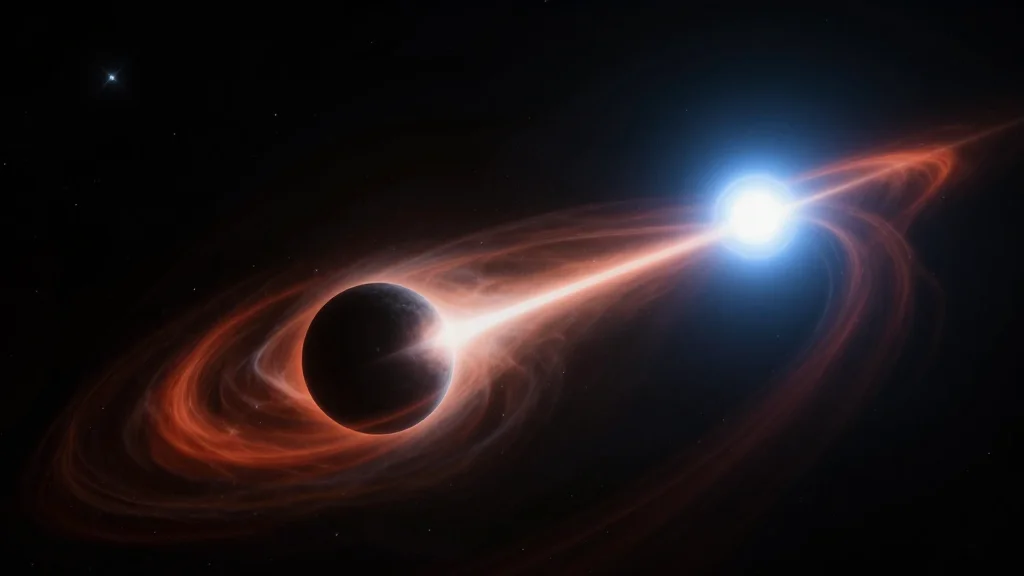
Stellar Winds Bend Cygnus X-1 Black Hole Jets, New Study Shows

Why It Matters
Understanding how stellar winds interact with black‑hole jets reshapes our picture of energy feedback in the cosmos. Jet‑driven feedback is a cornerstone of models that explain how black holes regulate star formation in galaxies; if winds can modulate jet direction and power, those models may need revision. Moreover, the finding provides a tangible laboratory for testing relativistic magnetohydrodynamic simulations, bridging the gap between theory and observation. The result also highlights the importance of multi‑wavelength, high‑resolution observations in uncovering subtle dynamical processes that were previously hidden. By demonstrating that ordinary stellar processes can influence extreme relativistic phenomena, the study opens new avenues for exploring the co‑evolution of black holes and their stellar environments.
Key Takeaways
- •Cygnus X-1’s companion star loses mass at a rate 100 million times that of the Sun, with wind speeds three times higher.
- •New high‑resolution images show the black‑hole jets bending in response to the stellar wind.
- •Jets extend roughly 16 light‑years, inflating a hot‑gas bubble in the interstellar medium.
- •The discovery challenges the assumption that jets dominate feedback without significant wind influence.
- •Future observations will target other X‑ray binaries to assess how common wind‑jet interactions are.
Pulse Analysis
The Cygnus X-1 discovery arrives at a moment when astrophysicists are re‑examining the balance of forces that shape cosmic structures. Historically, jet feedback has been treated as a one‑way street: black holes launch powerful, collimated outflows that carve cavities in their host galaxies, suppressing star formation. This new evidence of wind‑induced jet bending suggests a two‑way interaction, where the surrounding stellar environment can feed back on the jet itself. Such a feedback loop could explain observed irregularities in jet morphology across a range of scales, from microquasars to radio‑loud quasars.
From a theoretical standpoint, incorporating wind pressure into relativistic magnetohydrodynamic simulations will likely produce more realistic jet structures, including knots, bends, and instabilities that match observations. The finding also underscores the value of binary systems as natural laboratories; the proximity and well‑characterized parameters of Cygnus X-1 allow precise measurements that are impossible for distant active galactic nuclei. As next‑generation observatories come online, we can expect a surge of similar studies that will refine our understanding of how black holes and their stellar companions co‑evolve.
In practical terms, the result may influence how astronomers interpret jet‑related phenomena such as high‑energy neutrino production and gamma‑ray flares. If wind interactions can redirect jet material, they could create localized shock fronts that accelerate particles to extreme energies, offering new explanations for transient high‑energy events. The broader implication is clear: the cosmos is a dynamic interplay of forces, and even the most extreme objects are not immune to the influence of their more mundane neighbors.
Stellar Winds Bend Cygnus X-1 Black Hole Jets, New Study Shows
Comments
Want to join the conversation?
Loading comments...