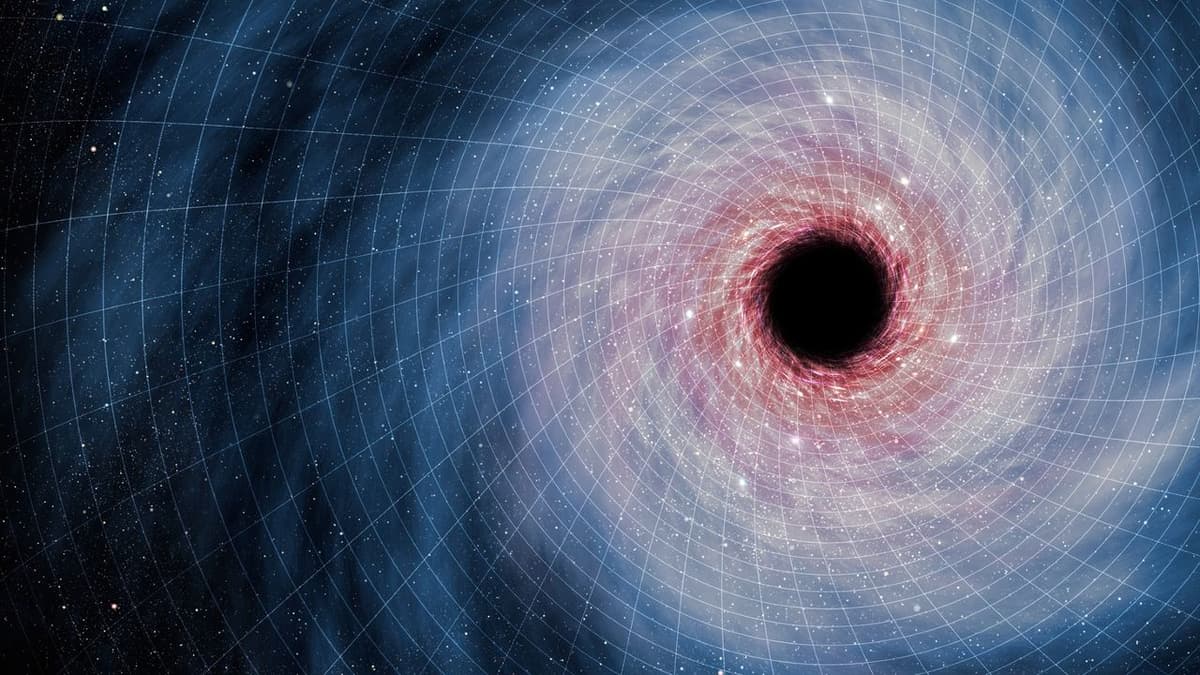
Stephen Hawking's Black Hole Information Paradox Could Be Solved — if the Universe Has 7 Dimensions
Why It Matters
If correct, the theory provides a concrete pathway to reconcile quantum mechanics with general relativity and reshapes expectations for black‑hole end‑states, influencing future quantum‑gravity research.
Key Takeaways
- •Seven‑dimensional G₂ geometry generates torsion that stops black‑hole evaporation
- •Remnants weigh ~9 × 10⁻⁴¹ kg, storing all infalling information
- •Model predicts Kaluza‑Klein particles near 10¹⁶ GeV, far beyond current colliders
- •Links torsion field to Higgs‑like potential, tying gravity to electroweak scale
Pulse Analysis
The information‑loss paradox has haunted physicists since Stephen Hawking showed that black holes emit thermal radiation and, in theory, could vanish completely. That disappearance would erase the quantum details of everything that fell in, contradicting the principle that information is never destroyed. Over the decades, proposals ranging from holographic dualities to firewalls have attempted to patch the gap, but none have offered a testable mechanism that bridges general relativity and quantum theory.
The March 2026 paper introduces a seven‑dimensional framework built on G₂‑manifold geometry, a structure familiar from M‑theory. In this picture, three extra dimensions are compactified so tightly that they manifest only as a torsion field—a twisting of spacetime that becomes repulsive at Planck‑scale distances. As a black hole shrinks via Hawking radiation, this torsion-generated force counteracts further loss, freezing the object into a remnant roughly 9 × 10⁻⁴¹ kg in mass. Crucially, the remnant’s quasinormal modes can encode the original information, preserving quantum unitarity without violating known physics.
Beyond the paradox, the model weaves together disparate areas of high‑energy physics. The same torsion potential mirrors the Higgs‑like field that gives mass to W and Z bosons, suggesting a deep geometric origin for electroweak symmetry breaking. Although direct detection of the predicted 10¹⁶ GeV Kaluza‑Klein excitations is beyond today’s colliders, indirect signatures—such as anomalous gamma‑ray bursts from primordial black‑hole remnants—could become observable with next‑generation telescopes. If future observations support these predictions, the theory would mark a pivotal step toward a unified quantum‑gravity description, reshaping both cosmology and particle physics.
Stephen Hawking's black hole information paradox could be solved — if the universe has 7 dimensions
Comments
Want to join the conversation?
Loading comments...