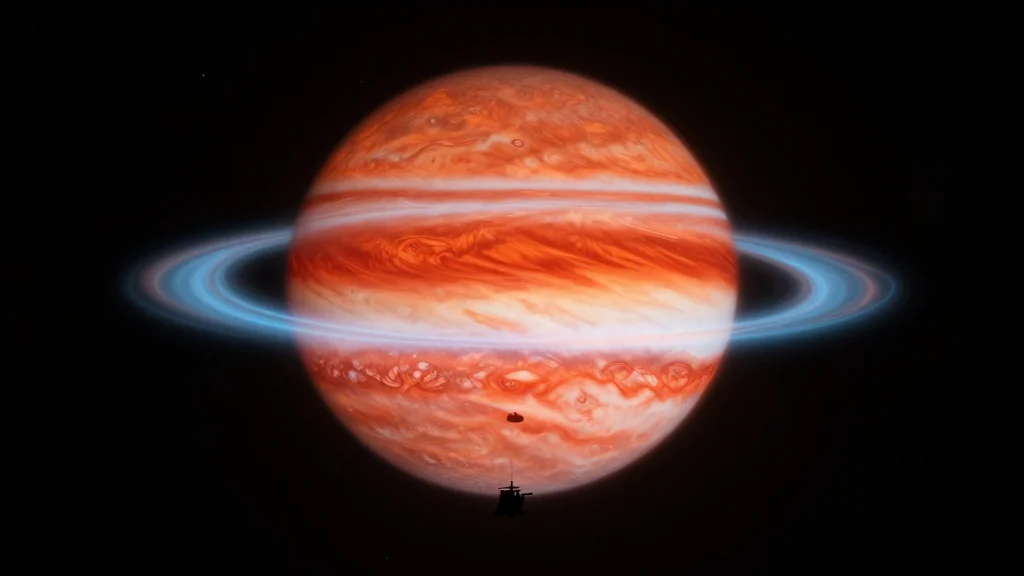
Strange Winds Reveal Strongest Hints Yet of Magnetic Activity in Exoplanets
Why It Matters
Confirming magnetic activity on exoplanets reshapes models of atmospheric escape and habitability, impacting future target selection for biosignature searches.
Key Takeaways
- •Fast ion winds exceed 5 km s⁻¹ on observed hot Jupiters
- •Magnetic signatures correlate with host star activity cycles
- •Magnetically driven escape could thin atmospheres over billions of years
- •New data refine models of exoplanetary magnetospheres
- •Findings guide JWST and ELT observation strategies
Pulse Analysis
The discovery of high‑velocity, magnetically driven winds marks a turning point in exoplanet science. While previous studies hinted at magnetic fields through radio emissions or auroral flashes, this research directly links wind dynamics to magnetic forces. By analyzing spectral line broadening and temporal variability, scientists distinguished magnetic drag from pure thermal expansion, delivering the most compelling proof that many close‑in gas giants generate substantial magnetic fields despite their extreme irradiation.
Understanding exoplanet magnetism is crucial for assessing atmospheric retention. Magnetic fields can shield a planet’s upper atmosphere from stellar wind stripping, yet they also channel charged particles that can accelerate atmospheric loss. The observed winds suggest a complex interplay: magnetic pressure drives fast, ionized streams that may both protect deeper layers and facilitate escape at the poles. This dual role refines predictions of how quickly hot Jupiters shed mass, informing theories about their evolution into smaller, rocky cores.
The implications extend to the search for habitable worlds. If magnetic activity can be detected on smaller, temperate exoplanets, it could become a key criterion for habitability assessments. Future missions such as the James Webb Space Telescope and the upcoming Extremely Large Telescope will leverage these insights, targeting planets where magnetic shielding may preserve atmospheres conducive to life. As observational techniques improve, magnetic field measurements will likely become a standard diagnostic in exoplanet characterization, shaping the next generation of planetary science.
Strange Winds Reveal Strongest Hints Yet of Magnetic Activity in Exoplanets
Comments
Want to join the conversation?
Loading comments...