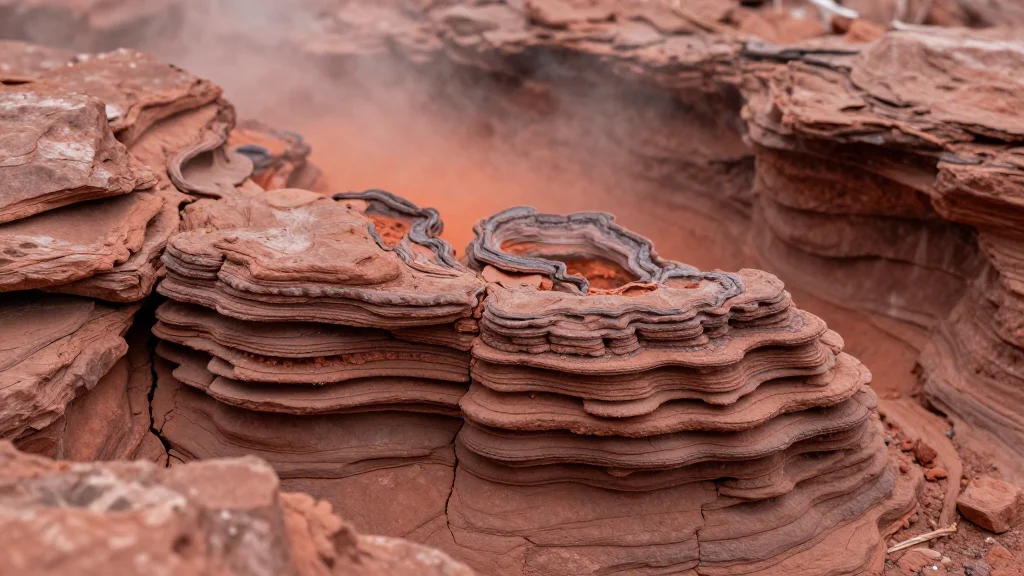
Stromatolites Discovered Beneath 42,000‑Year‑Old Korean Impact Crater

Why It Matters
The Korean stromatolite discovery reshapes our understanding of how life can persist amid planetary upheaval. By demonstrating that asteroid impacts can generate habitable hydrothermal niches, the research bridges a gap between catastrophic events and the continuity of early biospheres, informing models of Earth's early climate and the resilience of life. For astrobiology, the findings provide a concrete analogue for interpreting mineral and morphological signatures on other worlds. If impact craters can host life‑supporting environments on Earth, similar structures on Mars or icy moons like Europa may be prime targets for future life‑detection missions, refining the search strategy for extraterrestrial biosignatures.
Key Takeaways
- •Stromatolites identified beneath Jeokjung‑Chogye Basin, a 42,000‑year‑old impact crater in South Korea
- •Research led by geologist Jaesoo Lim of KIGAM, published in *Communications Earth & Environment*
- •Evidence suggests a long‑lasting hydrothermal system created by impact heat
- •Findings support the idea that asteroid impacts could provide refugia for early microbial life
- •Implications extend to astrobiology, guiding the search for life in impact craters on Mars and icy moons
Pulse Analysis
The Korean discovery arrives at a moment when the scientific community is re‑evaluating the dual nature of asteroid impacts. Historically framed as extinction drivers, impacts are now being reconsidered as engines of ecological opportunity. The Jeokjung‑Chogye stromatolites provide a rare, well‑dated case study that links impact physics to biological response, offering a data point that can calibrate models of early Earth habitability.
From a competitive standpoint, the study underscores the growing importance of interdisciplinary teams that combine geophysics, geochemistry, and microbiology. KIGAM’s ability to secure high‑resolution imaging and radiocarbon facilities positions South Korea as a hub for impact‑related paleo‑environmental research, potentially attracting international collaborations and funding.
Looking ahead, the implications for planetary exploration are profound. Mission planners for Mars sample‑return and Europa lander concepts can now prioritize crater interiors as high‑potential sites for biosignature preservation. If future missions confirm similar hydrothermal signatures, the paradigm shift could accelerate investment in drilling technologies and in‑situ analysis tools, reshaping the roadmap for detecting life beyond Earth.
Stromatolites Discovered Beneath 42,000‑Year‑Old Korean Impact Crater
Comments
Want to join the conversation?
Loading comments...