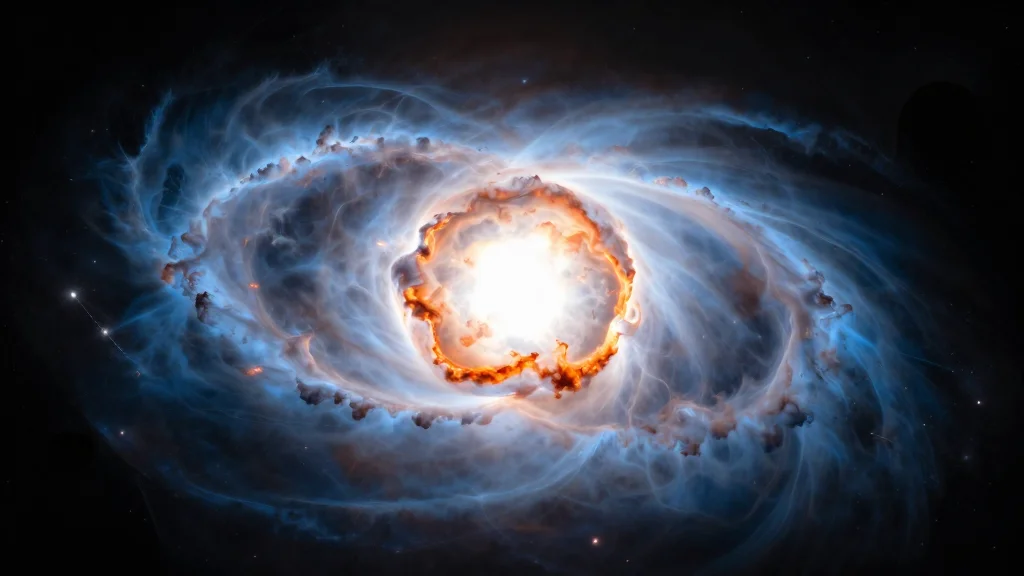
Study Finds Gravitational Waves Reveal a ‘Forbidden’ Black‑Hole Mass Gap

Why It Matters
The confirmation of a pair‑instability mass gap has far‑reaching consequences for our understanding of how massive stars end their lives. It resolves a long‑standing discrepancy between theoretical predictions and the observed black‑hole mass spectrum, sharpening models of stellar nucleosynthesis and the chemical enrichment of galaxies. For gravitational‑wave astronomy, the gap provides a clean diagnostic: any black hole detected within the forbidden range must have formed through a merger, offering a direct probe of hierarchical black‑hole assembly across cosmic time. Beyond astrophysics, the result showcases the power of multimessenger science. By extracting detailed information about stellar interiors from ripples in spacetime, researchers can study events that emit little or no light, expanding the observable universe to phenomena previously hidden from view. This capability will be crucial as next‑generation detectors push the frontier of sensitivity, potentially uncovering exotic objects such as primordial black holes or new physics beyond the Standard Model.
Key Takeaways
- •Nature paper led by Monash University identifies a ‘forbidden’ black‑hole mass gap (≈50‑120 M☉).
- •Gravitational‑wave data from LIGO‑Virgo‑KAGRA show no stellar‑origin black holes in this range.
- •Pair‑instability supernovae completely destroy stars, leaving no compact remnant.
- •Any black holes found in the gap must be merger products, not direct stellar collapses.
- •Future detector upgrades will test the gap’s limits and refine stellar‑evolution models.
Pulse Analysis
The detection of a clear pair‑instability gap is a watershed for both theoretical astrophysics and observational gravitational‑wave science. For decades, models have predicted that stars above a certain core mass become unstable, converting radiation pressure into electron‑positron pairs and detonating in a super‑luminous explosion. Yet the lack of direct observations left the hypothesis in the realm of speculation. By leveraging the statistical power of dozens of merger events, the Monash team has turned a theoretical curve into an empirical boundary, effectively turning the black‑hole mass spectrum into a forensic tool for stellar death.
Historically, the black‑hole mass distribution has been shaped by two competing processes: direct collapse of massive stars and hierarchical mergers of smaller black holes. The newly confirmed gap forces a re‑evaluation of merger rate calculations, especially for the high‑mass tail that drives the most energetic gravitational‑wave signals. Population‑synthesis codes will need to incorporate a hard cutoff, which could lower predicted event rates for certain mass bins and shift expectations for future observatories. Moreover, the result may help resolve tensions in recent LIGO‑Virgo catalogs where a handful of high‑mass black holes appeared anomalously abundant; those outliers are now more plausibly interpreted as merger remnants.
Looking ahead, the gap offers a natural laboratory for testing exotic physics. If future runs uncover black holes within the forbidden range, it would imply either new formation channels—perhaps involving primordial black holes—or gaps in our understanding of pair‑instability physics. The upcoming sensitivity boost from LIGO‑India and the planned Einstein Telescope will dramatically increase the volume of space surveyed, turning the gap into a litmus test for the standard model of massive‑star evolution. In short, this discovery not only fills a missing piece of the cosmic puzzle but also sets the stage for the next generation of astrophysical breakthroughs.
Study Finds Gravitational Waves Reveal a ‘Forbidden’ Black‑Hole Mass Gap
Comments
Want to join the conversation?
Loading comments...