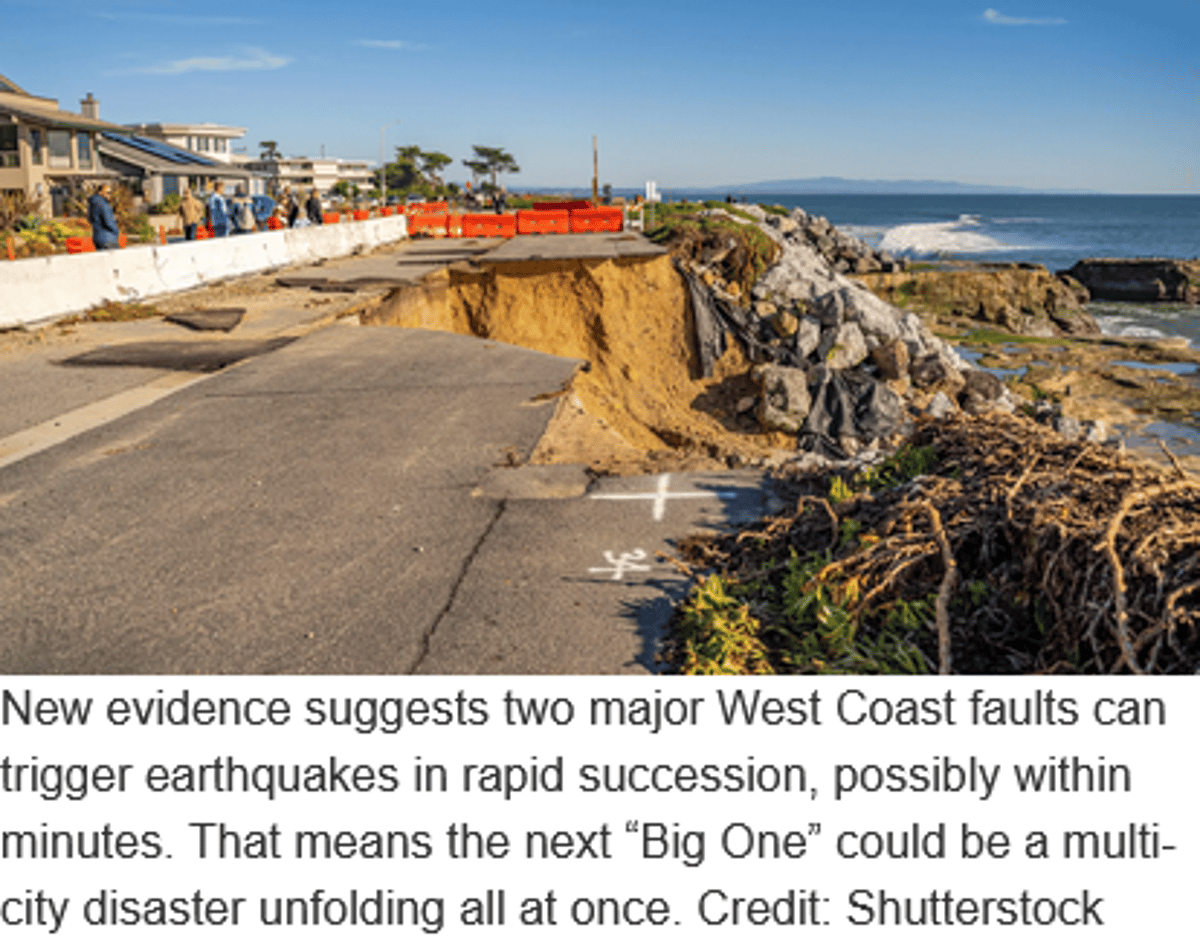
Study Finds Potential for Double West Coast Earthquake Threat
Companies Mentioned
Why It Matters
A coordinated rupture would stretch emergency resources and infrastructure, raising the stakes for regional disaster preparedness and insurance models. Understanding fault interaction reshapes seismic risk assessments for millions of residents and businesses on the West Coast.
Key Takeaways
- •Cascadia and San Andreas may trigger earthquakes within minutes
- •Sediment cores reveal “doublet” events over past 1,500 years
- •Three historic cases suggest synchronized quakes, including 1700 event
- •Dual fault rupture could strain emergency response across multiple cities
- •Study highlights need for coordinated West Coast seismic preparedness
Pulse Analysis
The new study leverages deep‑sea turbidite records to reveal a hidden pattern of paired earthquakes along the Cascadia subduction zone and the northern San Andreas fault. By dating sediment layers that flip from fine to coarse material, scientists identified three instances where the two systems likely ruptured within minutes, a phenomenon previously documented only in rare global cases like Sumatra. This geological detective work expands our understanding of fault dynamics beyond isolated events, suggesting that stress transfer between adjacent plates can produce rapid, multi‑fault failures.
For insurers, city planners, and emergency managers, the prospect of simultaneous megathrust and strike‑slip earthquakes forces a rethink of existing risk models. Traditional scenarios assume a single‑fault event, allowing resources to be concentrated on one epicenter. A double‑fault rupture would generate overlapping shockwaves, tsunami threats, and cascading infrastructure failures across Seattle, Portland, San Francisco and Vancouver. Consequently, building codes, retrofitting priorities, and mutual‑aid agreements must account for a compressed response window and broader geographic impact.
Policymakers are now faced with the challenge of fostering cross‑state coordination on seismic monitoring, early‑warning systems, and disaster drills. The study underscores the value of interdisciplinary research—combining marine geology, radiocarbon dating, and fault mechanics—to anticipate complex hazard scenarios. Future work will likely focus on high‑resolution modeling of stress interactions and real‑time sensor networks that could detect the initial tremor and issue alerts for the secondary fault. Proactive investment in these capabilities could mitigate the compounded losses of a double‑hit earthquake.
Study Finds Potential for Double West Coast Earthquake Threat
Comments
Want to join the conversation?
Loading comments...