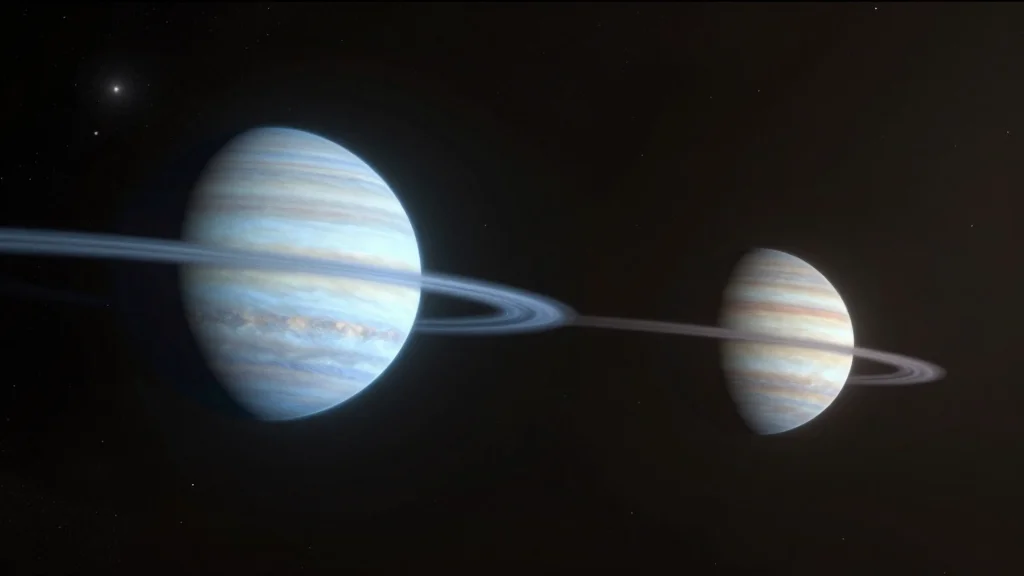
Study Suggests Early Solar System Lost Two Ice Giants, Upending Nice Model

Why It Matters
The possibility that the early Solar System ejected two ice giants reshapes fundamental assumptions about planetary migration and stability. It challenges the Nice model, which has been a cornerstone for explaining the arrangement of giant planets, the Late Heavy Bombardment, and the distribution of small bodies. A revised model could alter how scientists interpret the formation histories of exoplanetary systems, many of which show evidence of planet‑planet scattering and ejection. Moreover, the study highlights the need to integrate satellite dynamics into broader planetary formation theories. Understanding why Uranus’s moons appear relatively undisturbed despite a potentially violent past can inform models of moon formation and survival, with implications for the habitability of moons around exoplanets.
Key Takeaways
- •Simulations suggest the early Solar System may have expelled two ice‑giant planets.
- •Uranus’s moons would have experienced multiple collisions under the two‑giant scenario.
- •The findings challenge the current Nice model of planetary migration.
- •Implications extend to exoplanet systems where planet ejection is observed.
- •Further observations of Kuiper Belt objects and Uranian moons are needed to test the hypothesis.
Pulse Analysis
The new study by Clement et al. arrives at a time when the Nice model is both celebrated for its explanatory power and scrutinized for its limitations. Historically, the model has been lauded for linking giant‑planet migration to the Late Heavy Bombardment, but it has struggled to account for the detailed architecture of satellite systems. By focusing on Uranus’s moons, the researchers expose a blind spot in the model’s granularity, suggesting that the early Solar System may have been more chaotic than previously thought.
If the Solar System indeed lost two ice giants, it aligns with growing evidence from exoplanet surveys that planet‑planet scattering and ejection are common outcomes of dynamical instability. This convergence could prompt a paradigm shift: rather than viewing the Nice model as a singular narrative, scientists may adopt a suite of models that accommodate a spectrum of early‑system architectures, including scenarios with extra giants that are later removed. Such a shift would have ripple effects on how we interpret the distribution of free‑floating planets and the prevalence of compact, multi‑planet systems.
Looking ahead, the study underscores the importance of high‑resolution observations of distant Solar System bodies. Missions targeting the Kuiper Belt and improved imaging of Uranus’s moons could provide the empirical data needed to validate or refute the ejection hypothesis. Until then, the debate over the Nice model’s completeness will likely intensify, driving a new wave of simulations that blend large‑scale migration with the nuanced dynamics of satellite systems.
Study Suggests Early Solar System Lost Two Ice Giants, Upending Nice Model
Comments
Want to join the conversation?
Loading comments...