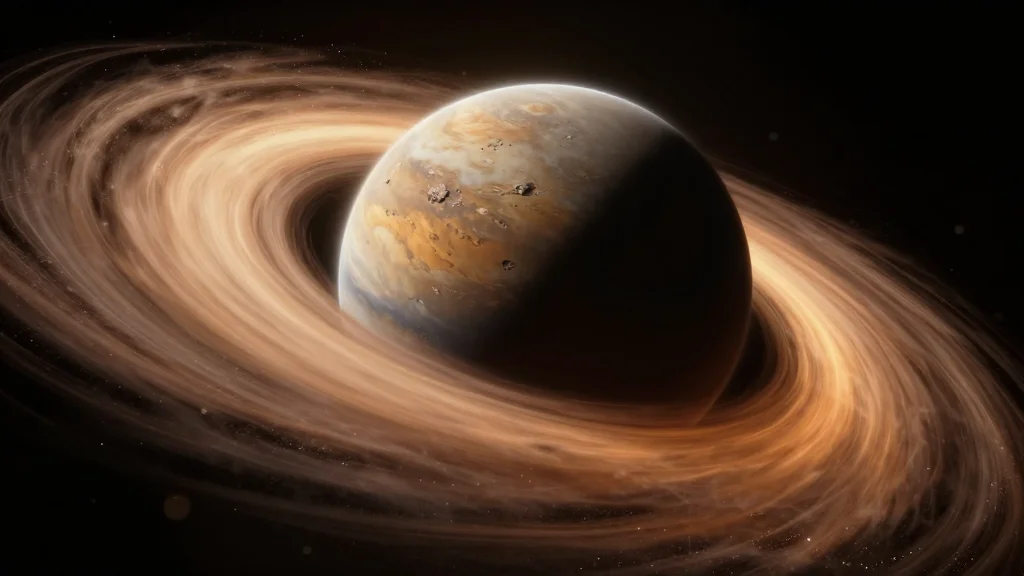
Study Suggests Supermassive Black Hole Discs Could Spawn Millions of Planets

Why It Matters
Understanding that planet formation can occur in the extreme environs of active galactic nuclei expands the known habitats for planetary systems, challenging the conventional view that stable planets only arise in relatively calm, star‑centric discs. This insight could reshape models of galaxy evolution, as the presence of massive planets may influence the dynamics and chemistry of the central regions. Moreover, the potential discovery of such planets would open a new frontier for exoplanet science, prompting the development of observational techniques capable of probing the innermost parts of galaxies. The study also bridges two traditionally separate fields—black‑hole astrophysics and planetary science—highlighting how processes at vastly different scales can intersect. If planets can survive the intense radiation and tidal forces near a supermassive black hole, it raises profound questions about the resilience of planetary systems and the possible pathways for complex chemistry in environments previously deemed hostile.
Key Takeaways
- •Theoretical model shows AGN accretion discs can produce millions of rocky planets.
- •Planet formation is driven by efficient dust coagulation under extreme pressure and temperature.
- •Predicted planetary masses range from Earth‑size to several Jupiter masses.
- •Observational tests include searching for disc gaps with ALMA and flares from migrating planets.
- •If confirmed, the finding adds a new class of planetary systems at galactic centers.
Pulse Analysis
The proposal that supermassive black‑hole discs can act as planetary nurseries flips a long‑standing assumption that the chaotic cores of galaxies are barren of stable worlds. Historically, planet formation theory has been anchored in the calm, rotating discs around young stars, where temperature gradients and low radiation levels allow dust to coalesce. By extending the framework to the high‑energy, high‑density environment of an AGN, the study forces a reconsideration of the minimum conditions required for planet birth.
From a market perspective, the research could stimulate a wave of instrument development aimed at resolving fine‑scale structures in distant galactic nuclei. Companies that supply high‑precision interferometric arrays or adaptive‑optics systems may see increased demand as astronomers chase the subtle signatures of planet‑induced disc perturbations. Funding agencies might also prioritize proposals that link black‑hole physics with exoplanet science, recognizing the interdisciplinary appeal.
Looking ahead, the key to validating the model lies in direct or indirect detection of these hypothesized planets. Upcoming facilities like the James Webb Space Telescope, with its infrared sensitivity, and the Extremely Large Telescope, with unprecedented spatial resolution, are poised to probe the dusty hearts of nearby active galaxies. Successful observations would not only confirm a novel planet‑formation pathway but also broaden the search for biosignatures to regions previously excluded from habitability assessments. Until then, the theory remains a provocative reminder that the universe may harbor worlds in the most unexpected corners.
Study suggests supermassive black hole discs could spawn millions of planets
Comments
Want to join the conversation?
Loading comments...