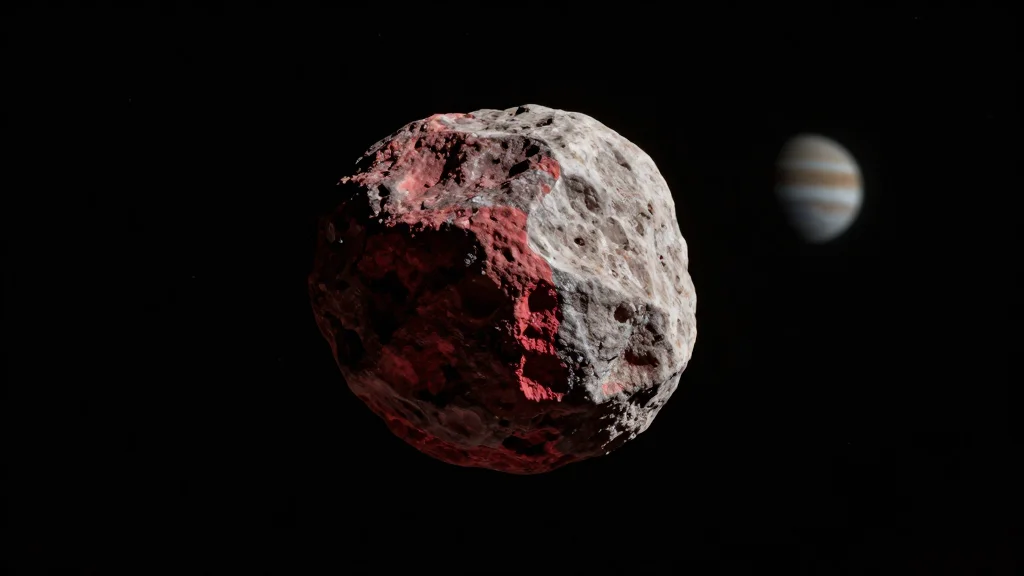
Subaru Telescope Sheds Light on Jupiter Trojan Asteroids' Color Mystery
Why It Matters
The findings overturn assumptions about compositional segregation among Trojans, reshaping theories of early solar‑system migration and planetesimal formation. They also give mission teams a refined framework for interpreting upcoming spacecraft observations.
Key Takeaways
- •Small Trojans show continuous color spectrum, no red/less‑red split.
- •Less‑red objects dominate among kilometer‑sized Trojans.
- •Size distribution identical for red and less‑red small asteroids.
- •Findings dispute fragmentation hypothesis linking red to less‑red fragments.
- •Results aid JUICE and Lucy mission analyses of Trojan origins.
Pulse Analysis
Jupiter Trojan asteroids have long been regarded as time capsules from the solar system’s infancy, preserving the chemical fingerprints of the region where they formed. Larger Trojans exhibit a stark bimodal color split—red D‑type and less‑red P/C‑type—suggesting distinct origins or migration pathways. Understanding whether this dichotomy extends to smaller bodies is crucial, because fragments retain interior composition that surface weathering can obscure.
The Subaru Telescope’s final night with the Suprime‑Cam camera offered a rare opportunity to capture rapid, multicolor photometry of faint, kilometer‑scale Trojans. By surveying a swath 60 degrees ahead of Jupiter, the team cataloged 120 objects and measured their reflectance across several filters. Their analysis revealed a smooth color continuum among the small Trojans, with less‑red hues prevailing, and showed that size distributions do not differ between red and less‑red groups. This continuity contradicts the prevailing fragmentation model that predicts red parents should produce a surplus of less‑red fragments.
These results carry weight for planetary formation narratives that invoke giant‑planet migration to redistribute primitive bodies. A unified collisional history implies that the two color families likely originated from a common source region before being shepherded into Jupiter’s Lagrange points. As ESA’s JUICE mission and NASA’s Lucy spacecraft prepare for close flybys, the Subaru findings provide a vital baseline for interpreting in‑situ compositional data. Integrating ground‑based color surveys with spacecraft measurements will sharpen models of early solar‑system dynamics and the processes that shaped the small‑body reservoirs we observe today.
Subaru Telescope sheds light on Jupiter Trojan asteroids' color mystery
Comments
Want to join the conversation?
Loading comments...