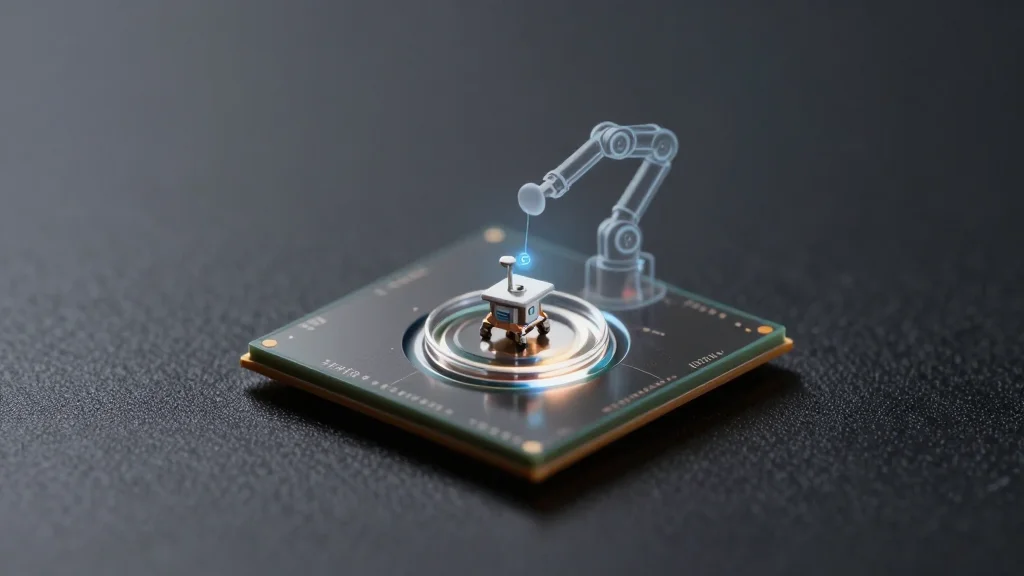
Success Stories: Smart Sensor, Smarter Decisions
Why It Matters
On‑device data processing eliminates latency and power penalties of cloud‑based AI, a game‑changer for medical, space and edge‑computing markets that demand instant, reliable decisions.
Key Takeaways
- •Electrochromic hyperspectral embedding processes data inside the sensor.
- •Enables real‑time tumor detection for surgical robots.
- •Allows lunar rovers to analyze rocks without Earth communication delay.
- •Targets low‑cost, scalable manufacturing for edge AI devices.
Pulse Analysis
Edge computing has become the linchpin of modern autonomous systems, yet many devices still rely on bulky processors or remote servers to make sense of raw sensor streams. The new electrochromic hyperspectral embedding approach flips this model by embedding spectral analysis directly within the optical sensor matrix. This on‑sensor computation reduces data bandwidth requirements, cuts latency to microseconds, and dramatically lowers power draw—attributes that are especially valuable in environments where every milliwatt counts, such as implantable medical tools or battery‑limited planetary rovers.
The core of the technology leverages electrochromic materials that change optical properties in response to electrical stimuli, enabling the sensor to perform hyperspectral decomposition without external hardware. By integrating this capability, the sensor can generate compressed, information‑rich representations that are instantly interpretable by lightweight AI algorithms. For surgical robotics, this means the instrument can differentiate malignant tissue from healthy cells in real time, enhancing precision and patient outcomes. In lunar exploration, rovers equipped with such sensors could assess mineral composition on‑site, bypassing the need for delayed transmission to Earth and accelerating scientific discovery.
Commercially, the framework opens a pathway to mass‑produced, cost‑effective edge AI devices. Researchers are already exploring roll‑to‑roll manufacturing techniques that could bring unit costs down to consumer‑electronics levels. As industries—from healthcare to aerospace—seek to embed intelligence at the point of capture, the ability to deliver high‑resolution spectral insight without heavyweight processors positions this technology as a foundational building block for the next generation of smart, autonomous systems.
Success Stories: Smart Sensor, Smarter Decisions
Comments
Want to join the conversation?
Loading comments...