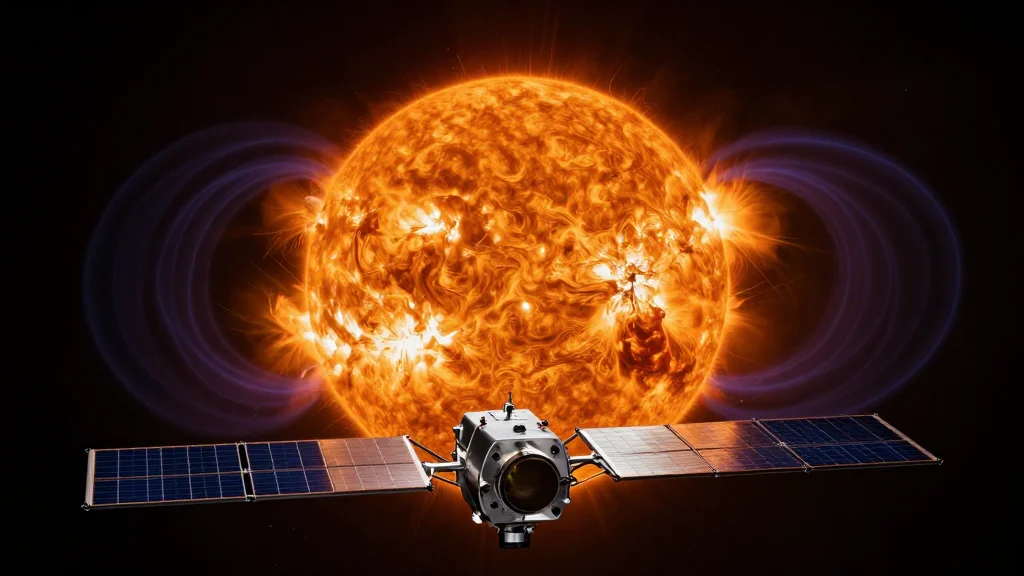
Sun Emits Record‑Breaking 19‑Day Radio Burst, Tracked by Four NASA Spacecraft

Why It Matters
The 19‑day solar radio burst provides an unprecedented window into the mechanisms that sustain energetic particles in the Sun’s outer atmosphere. Understanding these mechanisms is essential for improving space‑weather forecasts, which protect satellite operations, aviation routes, and ground‑based power infrastructure from solar‑induced disturbances. Moreover, the successful coordination of four spacecraft demonstrates a model for future multi‑platform solar monitoring, potentially enabling earlier warnings of more dangerous solar events. Beyond practical forecasting, the event challenges existing theories of magnetic confinement and particle acceleration in stellar atmospheres. By extending the known duration of coherent radio emissions, the data compel theorists to revisit models of magnetic funnel stability and electron trapping, with implications that may extend to other magnetically active stars.
Key Takeaways
- •Sun produced a continuous radio burst lasting 19 days (Aug 21–Sep 9, 2025), four times longer than any previously recorded event.
- •The burst was observed by Solar Orbiter, Parker Solar Probe, Wind and STEREO‑A, providing a multi‑point view of the phenomenon.
- •Researchers identified a funnel‑type magnetic structure in the Sun’s outer atmosphere as the source of the sustained emission.
- •Previous longest solar radio burst lasted five days; this new record offers a unique dataset for particle‑acceleration studies.
- •Data will inform space‑weather models and guide future missions such as NASA’s Solar Sentinels and ESA’s continued Solar Orbiter program.
Pulse Analysis
The record‑breaking solar radio burst underscores the value of a distributed observation network in heliophysics. Historically, single‑satellite measurements have limited the ability to track long‑duration events, often missing spatial context. By stitching together data from four distinct platforms, scientists not only confirmed the burst’s longevity but also pinpointed its magnetic origin, a feat unlikely with any single instrument. This collaborative approach mirrors trends in Earth observation, where constellations of small satellites provide continuous coverage; the solar community appears poised to adopt a similar paradigm.
From a scientific standpoint, the event forces a reassessment of how magnetic funnels can trap electrons for extended periods. Existing models predict rapid diffusion of energetic particles, yet the observed 19‑day coherence suggests a more stable magnetic topology, perhaps sustained by large‑scale solar dynamo processes. If such structures are more common than previously thought, they could play a role in modulating the Sun’s background radio noise, influencing how we interpret distant stellar radio emissions.
Operationally, the burst offers a test case for next‑generation forecasting algorithms that integrate real‑time radio observations. While the burst itself was harmless, the ability to detect and characterize similar signatures early could improve lead times for alerts about geomagnetic storms. As commercial satellite constellations expand and reliance on GPS grows, the economic stakes of accurate space‑weather prediction rise sharply. The data harvested from this event will likely feed machine‑learning models that aim to predict the onset of more disruptive solar activity, turning a scientific curiosity into a practical safeguard.
Looking ahead, the solar physics community will watch for repeat occurrences. If future missions detect comparable long‑duration bursts, the phenomenon may shift from an outlier to a recognized class of solar activity, prompting revisions to both theoretical frameworks and operational monitoring strategies.
Sun Emits Record‑Breaking 19‑Day Radio Burst, Tracked by Four NASA Spacecraft
Comments
Want to join the conversation?
Loading comments...