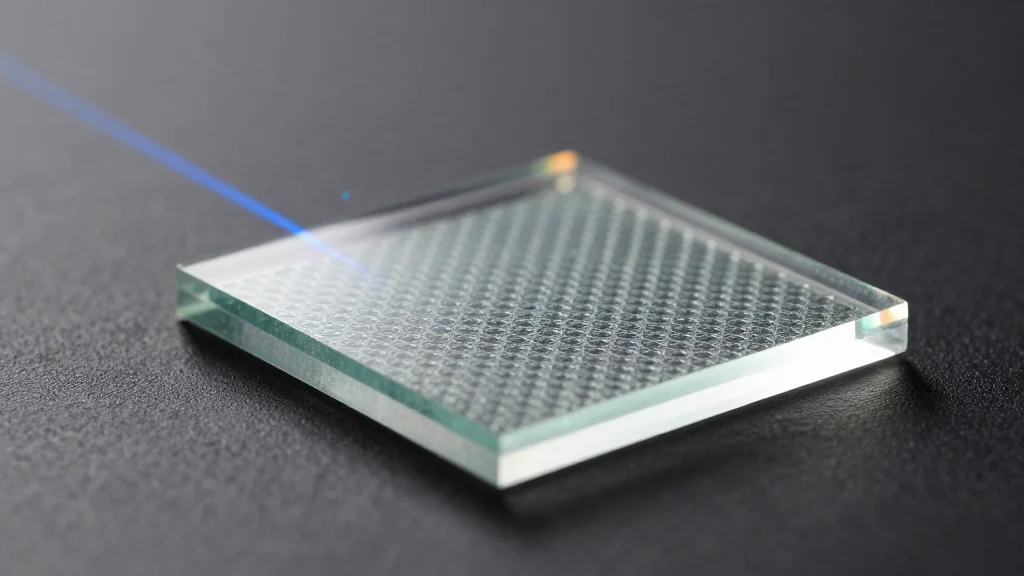
Surprising Scattering in Stealthy Structures
Why It Matters
The result shows that disorder‑engineered materials may not deliver the expected low‑loss optical performance, impacting designs for transparent optics, waveguides, and photonic devices.
Key Takeaways
- •Researchers built millimeter‑scale photonic crystal with millions of holes.
- •Introduced stealthy hyperuniform disorder by random hole size variation.
- •Measured photonic band structure, revealing unexpected scattering in transparency range.
- •Photon leakage modeled as complex mass, increasing scattering.
- •Findings challenge assumption of lossless wave propagation in hyperuniform materials.
Pulse Analysis
Stealthy hyperuniform materials have long intrigued physicists because their large‑scale uniformity can suppress density fluctuations, theoretically allowing light to pass without scattering across a designated wavelength window. Traditional models treat wave propagation as a conservative process, assuming that photons retain their energy while navigating the disordered landscape. This idealized picture underpins proposals for ultra‑transparent coatings, low‑loss waveguides, and novel photonic circuits that exploit disorder rather than periodicity to control light.
The Penn State team overcame a key experimental barrier by scaling up a two‑dimensional photonic crystal to a millimeter‑size slab containing millions of holes spaced half a micrometer apart. By randomly varying each hole’s diameter, they introduced stealthy hyperuniform disorder while preserving overall uniformity. Instead of measuring simple transmission, they probed the photonic band structure, a technique that reveals how modes evolve with wavelength and direction. The data showed pronounced scattering precisely where theory predicted transparency, a discrepancy traced to photon leakage out of the slab—a loss mechanism absent in earlier microwave or acoustic analogues.
These findings carry practical weight for the optics industry. Designers of photonic devices must now account for complex‑mass effects that introduce an imaginary component to photon propagation, effectively limiting the achievable low‑loss performance of hyperuniform structures. The work suggests that future research should focus on engineering confinement strategies or material platforms that mitigate leakage, potentially restoring the promised transparency. As photonic integration becomes ever more critical for data centers, sensing, and quantum technologies, understanding the true limits of disorder‑based optics will guide realistic roadmap planning.
Surprising Scattering in Stealthy Structures
Comments
Want to join the conversation?
Loading comments...