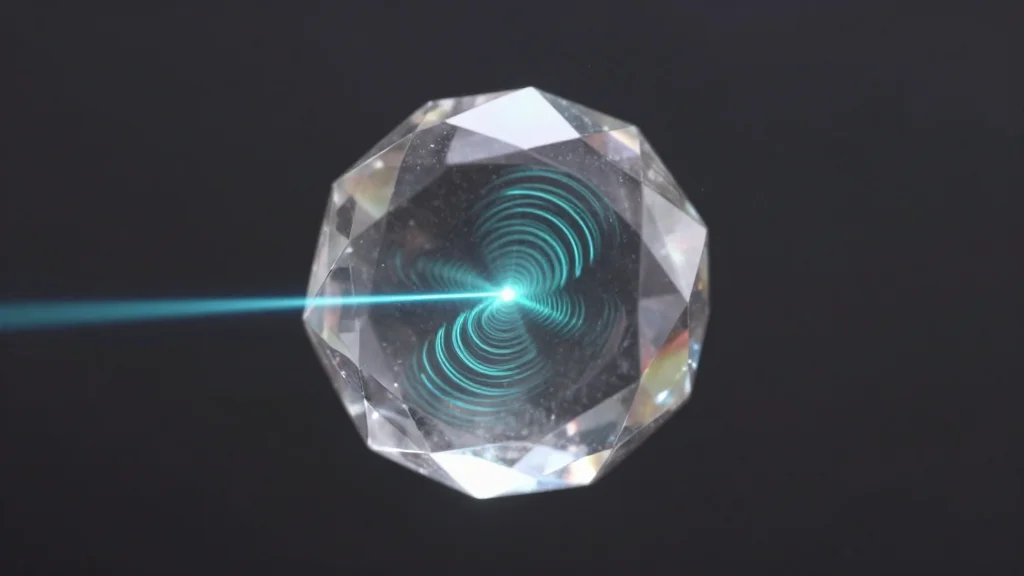
Symmetry Says These Crystal Vibrations Can Never Mix, but an Exotic Quantum Phase Rewrites the Rules
Why It Matters
By revealing a controllable bridge between otherwise isolated phonons, the work opens new routes for ultrafast control of quantum phases that were previously inaccessible, potentially accelerating the development of chiral optoelectronic devices.
Key Takeaways
- •Amplitudon fluctuations bridge phonons of different symmetry in ferroaxial crystals
- •Helicity‑resolved light scattering maps chiral domains via left/right circular response
- •Resonant energy matching amplifies vibrational coupling, observable at room temperature
- •Ultrafast lasers could selectively activate forbidden interactions in similar materials
- •Microscopic model links electronic amplitude mode to lattice dynamics across symmetries
Pulse Analysis
Ferroaxial order, a subtle form of chirality in layered crystals, has long evaded direct observation because it does not couple to conventional electric or magnetic fields. The charge‑density‑wave that underpins this state creates a periodic lattice distortion, yet its collective amplitude mode—known as the amplitudon—remains hidden in standard spectroscopies. By exploiting the handedness of circularly polarized light, the UT Austin‑Max Planck team turned the amplitudon into a diagnostic tool, allowing researchers to visualize chiral domains and track their dynamics in real time.
The breakthrough hinges on a resonant condition: when the energy of a conventional phonon matches that of the amplitudon, the two modes hybridize, producing a pronounced imbalance in left‑ versus right‑circular light scattering. This helicity‑dependent response provides a direct fingerprint of the ferroaxial phase and demonstrates that electronic fluctuations can temporarily lift symmetry‑imposed selection rules. The experiment’s room‑temperature operation underscores its practicality, suggesting that similar chiral dressing techniques could be applied to a broad class of quantum materials where hidden orders are masked by symmetry.
Beyond fundamental insight, the discovery paves the way for ultrafast control strategies. Tailored laser pulses tuned to the resonant energy could selectively excite the amplitudon, thereby inducing or suppressing specific phonon pathways on femtosecond timescales. Such capability promises new functionalities in chiral photonics, quantum information processing, and energy‑efficient switching devices. Future research will likely explore material families beyond 1T‑TaS₂, aiming to generalize the resonant chiral dressing concept and integrate it into scalable device architectures.
Symmetry says these crystal vibrations can never mix, but an exotic quantum phase rewrites the rules
Comments
Want to join the conversation?
Loading comments...