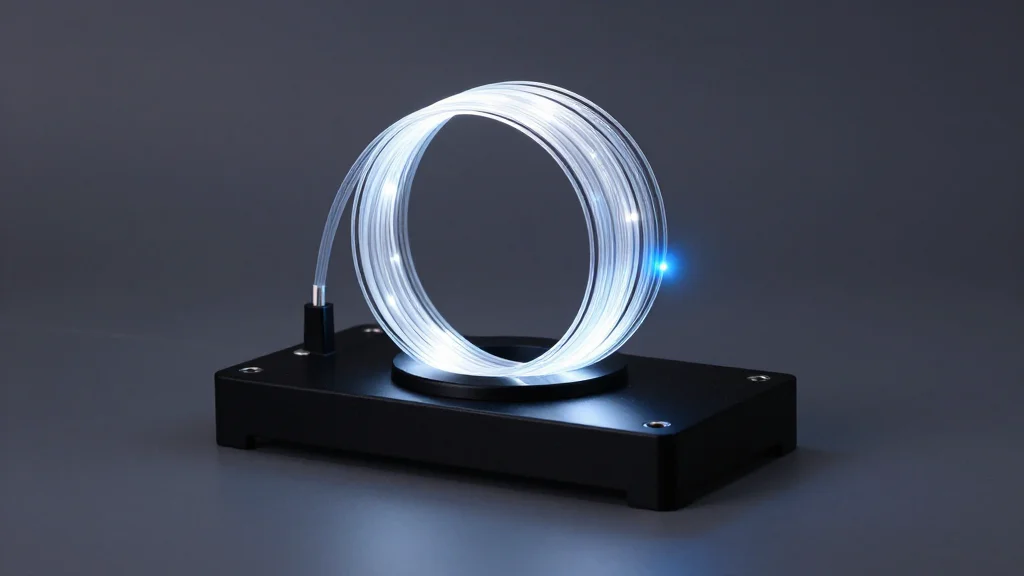
Tabletop Experiment Helps Reconcile Fundamental Physics
Why It Matters
The breakthrough provides the first laboratory‑scale tool to directly observe gravity’s effect on quantum systems, accelerating research toward a unified theory and informing precision‑measurement technologies.
Key Takeaways
- •50‑km fiber interferometer fits on a tabletop
- •Detects gravitationally induced phase shift with single photons
- •Bridges quantum mechanics and general relativity experimental gap
- •Enables lab‑scale tests of gravitational redshift in quantum systems
- •Opens new research avenues for quantum optics and precision sensing
Pulse Analysis
The quest to reconcile quantum mechanics with Einstein’s general relativity has long been hampered by the inability to observe gravity’s influence on individual quantum particles. Traditional experiments either lack the sensitivity to detect the minuscule gravitational signatures or require massive, costly infrastructure. Yu’s approach sidesteps these constraints by leveraging ultra‑stable fiber coils to create a 50‑kilometer optical path that can be coiled onto a benchtop, delivering unprecedented phase stability while keeping the apparatus compact and affordable.
At the heart of the experiment is a Mach‑Zehnder interferometer that splits single‑photon streams and recombines them after traversing the elongated fiber arms. The resulting interference pattern reveals a tiny phase shift caused by Earth's gravitational field, effectively measuring gravitational redshift at the quantum level. This level of precision, previously attainable only in large‑scale facilities like LIGO, demonstrates that tabletop setups can now probe the regime where quantum superposition and spacetime curvature intersect, opening a new experimental frontier for quantum gravity research.
Beyond fundamental physics, the technology promises practical applications in quantum sensing, navigation, and timekeeping. High‑precision interferometric measurements are essential for next‑generation atomic clocks and inertial sensors, where even subtle gravitational effects can impact performance. By proving that such sensitivity is achievable in a modest laboratory environment, Yu’s work could accelerate the commercialization of quantum‑enhanced devices and attract interdisciplinary collaborations, positioning academic labs as incubators for industry‑ready quantum technologies.
Tabletop experiment helps reconcile fundamental physics
Comments
Want to join the conversation?
Loading comments...