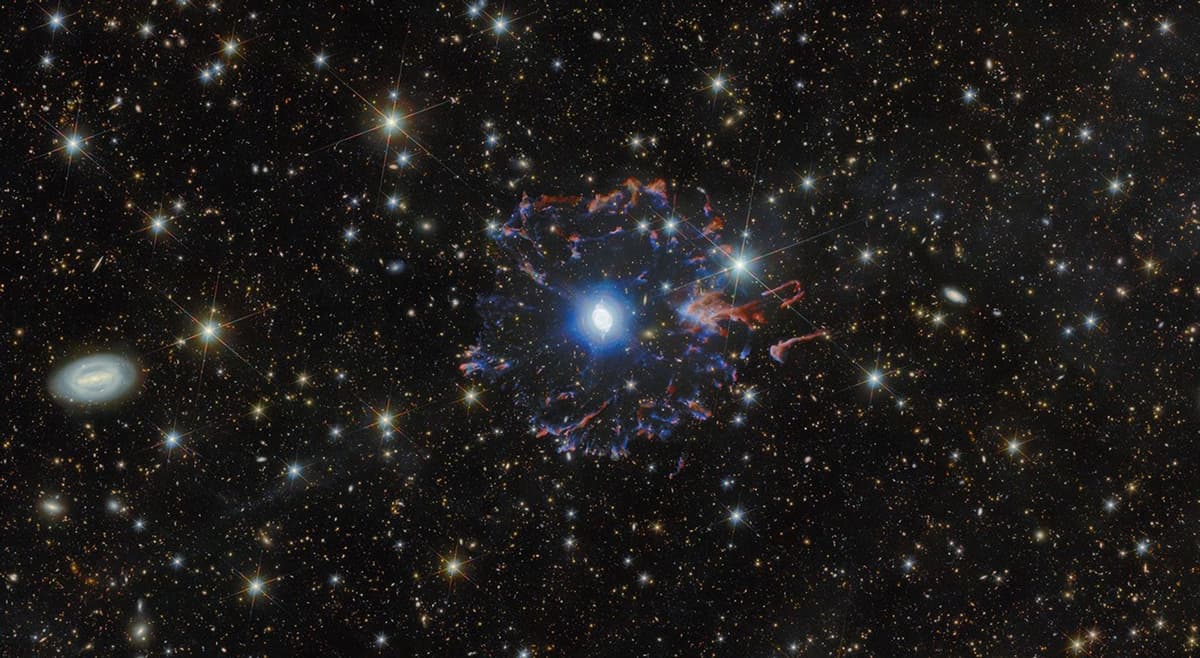
Telescopes Team Up for New View of Cat’s Eye Nebula
•March 11, 2026
0
Why It Matters
The partnership delivers richer, multi‑wavelength insights into how dying stars shed material, advancing astrophysical models and showcasing the value of cross‑agency data integration.
Key Takeaways
- •Euclid and Hubble combine visible and infrared data.
- •Reveals complex shells and jets in Cat’s Eye.
- •Provides new clues on planetary nebula formation mechanisms.
- •Demonstrates power of multi‑observatory collaborations for astrophysics.
- •Enhances public engagement with striking space imagery.
Pulse Analysis
The European Space Agency’s Euclid telescope, launched in 2023 to map dark energy, operates primarily in the near‑infrared, while NASA’s Hubble Space Telescope has delivered high‑resolution visible‑light images for three decades. By stitching Euclid’s infrared view with Hubble’s optical data, astronomers have produced a composite picture of the Cat’s Eye Nebula that captures both the glowing ionized gas and the cooler dust structures hidden from visible light. This synergy showcases how complementary wavelength coverage can turn a familiar object into a laboratory for testing theories of stellar death.
The merged image reveals a series of concentric shells, high‑speed jets, and intricate filamentary knots that were only hinted at in single‑instrument observations. Infrared data expose dense dust lanes that absorb and re‑emit starlight, while optical wavelengths trace the ionized gas illuminated by the central white dwarf. Together, they allow researchers to map temperature gradients, assess mass‑loss rates, and refine models of how planetary nebulae evolve from asymptotic giant branch stars. These details help resolve long‑standing debates about the role of binary companions in shaping nebular morphology.
Beyond the scientific payoff, the collaboration sets a precedent for future multi‑observatory campaigns, such as those planned with the James Webb Space Telescope and the upcoming Nancy Grace Roman Space Telescope. Joint datasets promise richer diagnostics for a wide range of cosmic phenomena, from galaxy formation to exoplanet atmospheres. Moreover, the striking visual of the Cat’s Eye, amplified by the dual‑telescope perspective, fuels public fascination and supports outreach initiatives that inspire the next generation of astronomers. As space agencies increasingly share data, the pace of discovery is likely to accelerate.
Telescopes Team Up for New View of Cat’s Eye Nebula
0
Comments
Want to join the conversation?
Loading comments...