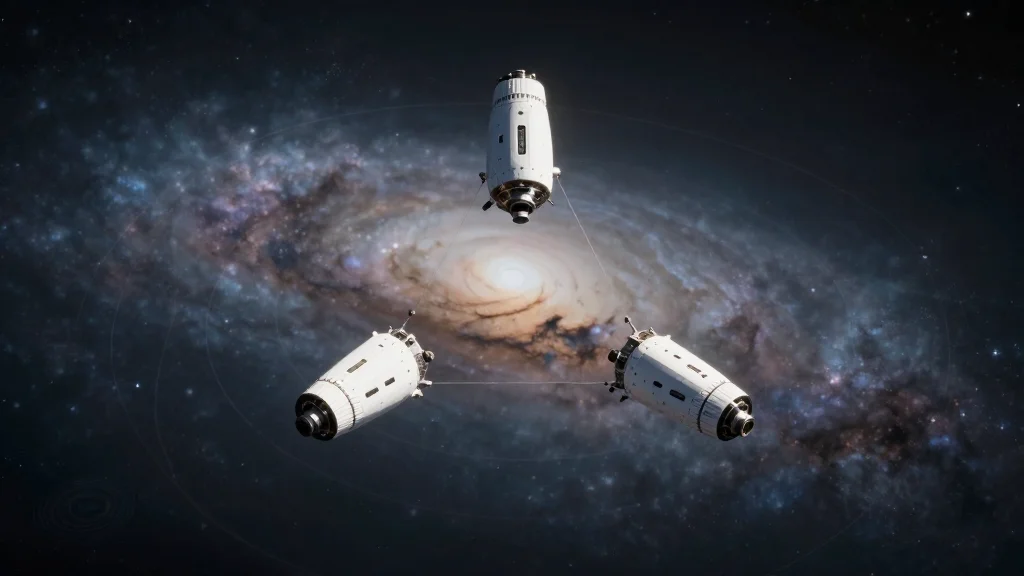
The Galaxy's Spin Is Hiding in the Hum of Gravitational Waves
Companies Mentioned

NASA
Why It Matters
Accurate modeling of the galactic wave background is essential for LISA to deliver reliable astrophysical catalogs, and the rotational signal provides an independent handle on Milky Way dynamics and dark‑matter distribution.
Key Takeaways
- •LISA will detect a persistent gravitational-wave background from Milky Way binaries
- •Galactic rotation induces a directional Doppler shift in the background signal
- •Ignoring the shift skews binary count and mass estimates at LISA’s precision
- •Incorporating the effect needs only a corrected template, no new parameters
Pulse Analysis
The Laser Interferometer Space Antenna (LISA) is poised to become the first space‑based observatory capable of listening to the faint hum of gravitational waves generated by countless compact binaries throughout our galaxy. Unlike transient events such as black‑hole mergers, this stochastic background forms a continuous signal that will dominate LISA’s low‑frequency band, providing a statistical census of binary populations and a new window onto stellar evolution. Understanding its shape and amplitude is therefore a cornerstone of LISA’s scientific return.
Researchers in Paris have now quantified how the Milky Way’s rotation imprints a subtle Doppler shift on the background, varying with sky direction. As stars orbit the Galactic center at roughly 230 km/s, the emitted gravitational waves are slightly stretched or compressed, analogous to the familiar red‑shift of light. The team derived an analytical template for this rotational boost and showed that omitting it would mischaracterize binary counts and masses by an amount comparable to LISA’s projected uncertainties. Incorporating the correction is straightforward—simply replace the isotropic template with the Doppler‑adjusted version, avoiding any additional free parameters.
Beyond data fidelity, the rotational signature offers a novel astrophysical probe. By measuring the anisotropic Doppler pattern, LISA could infer the Milky Way’s rotation curve independently of optical surveys, providing a direct test of the Galaxy’s mass distribution and the underlying dark‑matter halo. This cross‑validation could refine models of Galactic dynamics and improve constraints on dark‑matter density profiles. As LISA moves toward launch, accounting for the galactic spin will be essential both for precision gravitational‑wave astronomy and for unlocking a fresh, gravitational‑wave‑based perspective on our own cosmic neighborhood.
The galaxy's spin is hiding in the hum of gravitational waves
Comments
Want to join the conversation?
Loading comments...