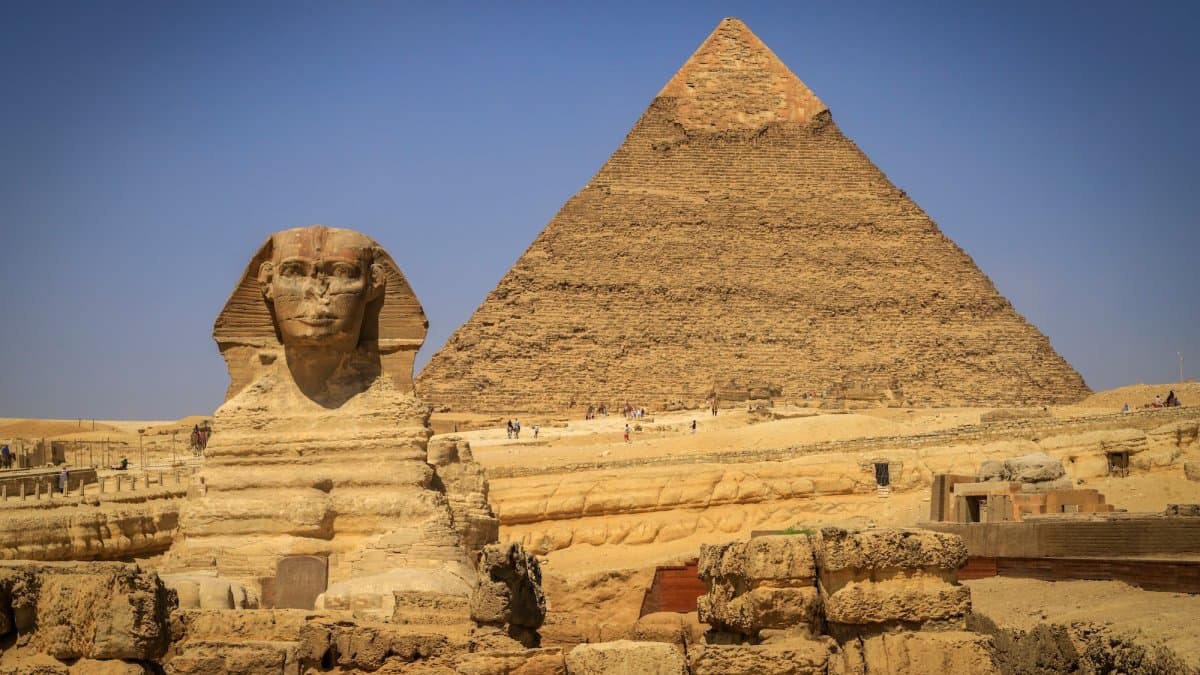
The Great Pyramid of Giza Is Surprisingly Earthquake-Proof
Why It Matters
Understanding the pyramid’s passive seismic resilience offers valuable clues for modern engineers seeking low‑tech, durable solutions, and it underscores the importance of preserving ancient sites that embody centuries of structural innovation.
Key Takeaways
- •Vibrations inside pyramid mostly 2.0–2.6 Hz, evenly distributed.
- •Soil vibrations around 0.6 Hz create frequency contrast aiding stability.
- •Relieving chambers act as built‑in shock absorbers.
- •Builders refined slope angles through centuries of trial and error.
- •Resilience likely a byproduct, not deliberate modern seismic engineering.
Pulse Analysis
The Great Pyramid’s endurance against earthquakes is more than a historical curiosity; it is a case study in passive seismic mitigation. By recording ambient vibrations across 37 locations, researchers discovered a clear frequency gap between the stone core (2.0‑2.6 Hz) and the surrounding desert soil (≈0.6 Hz). This disparity prevents resonant amplification, allowing seismic energy to dissipate rather than concentrate. Coupled with a limestone base that absorbs shock, the pyramid’s internal architecture—particularly the relieving chambers above the King’s Chamber—functions like a built‑in shock absorber, distributing stress throughout the massive stone mass.
These findings highlight how ancient Egyptian builders, through centuries of trial and error, honed slope angles and block placement to achieve structural balance. The evolution from simple mastabas to the Bent Pyramid and finally the Great Pyramid reflects a systematic refinement process, where each failure informed the next design iteration. Although there is no evidence of formal earthquake theory, the resulting geometry and material choices inadvertently created a structure that meets many criteria of modern seismic design, such as uniform stress distribution and vibration isolation.
For today’s engineers, the pyramid offers a blueprint for low‑cost, sustainable resilience. Its passive damping mechanisms can inspire contemporary projects in regions where high‑tech solutions are impractical. Moreover, the research reinforces the need to protect heritage monuments, not only for cultural reasons but also as living laboratories of engineering wisdom. Ongoing interdisciplinary studies may translate these ancient principles into next‑generation building codes, marrying millennia‑old intuition with cutting‑edge science.
The Great Pyramid of Giza is surprisingly earthquake-proof
Comments
Want to join the conversation?
Loading comments...