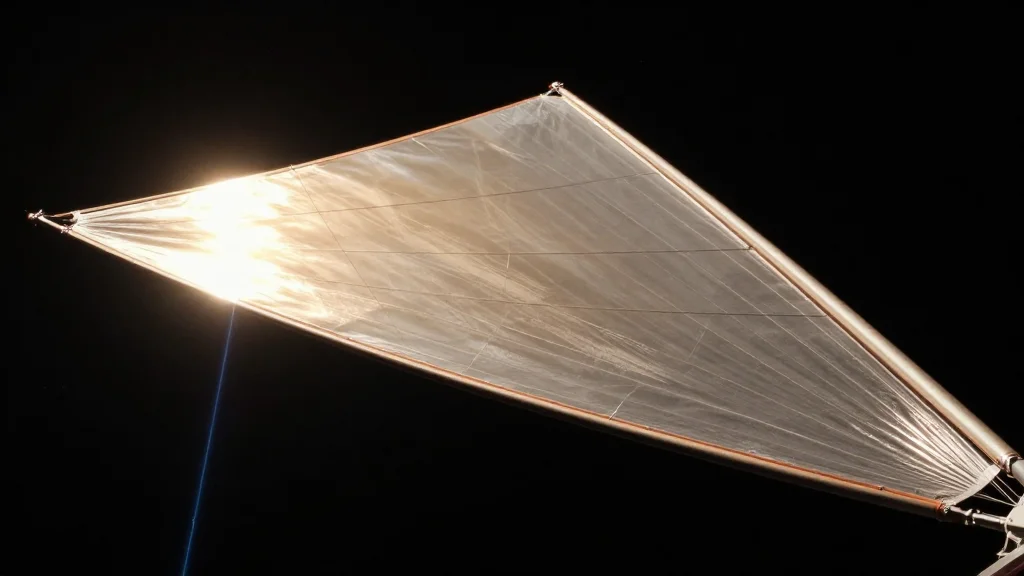
The Hidden Physics Complicating Interstellar Lightsails
Why It Matters
The identified drag limits achievable velocities, forcing redesign of sail materials and laser power budgets for interstellar missions. Ignoring this effect could lead to under‑performing probes and missed scientific opportunities.
Key Takeaways
- •Relativistic aberration turns diffuse scattering into drag above 0.75c
- •Thrust drops sharply due to Doppler‑shifted laser frequency at high speeds
- •Current sail designs assume ideal mirrors, ignoring material imperfections
- •Metamaterial sails could counteract aberration but remain experimental
- •Interstellar mission planners must factor radiative drag in trajectory models
Pulse Analysis
Solar sails harness photon momentum, converting the pressure of sunlight or a ground‑based laser into thrust. In the non‑relativistic regime the three contributors—direct photon incidence, specular reflection, and diffuse scattering—add linearly, giving a predictable acceleration profile. As a sail approaches a significant fraction of light speed, however, relativistic Doppler shift reduces the photon frequency seen by the sail, eroding the thrust from each component. Beyond roughly 0.75 c, relativistic light aberration redirects diffusely scattered photons forward, turning what was a minor push into a measurable drag force that slows further acceleration.
The findings force engineers to revisit the ideal‑mirror assumption that underpins most lightsail concepts. Real‑world sails will be built from metamaterials or photonic crystals tuned to the laser wavelength, and these structures can be engineered to minimize absorption and control scattering angles. Yet the current state of material science still leaves residual diffuse scattering, meaning the aberration‑induced drag cannot be ignored in trajectory calculations. Incorporating active beam‑steering or adaptive sail surfaces could mitigate the effect, but such technologies add complexity, mass, and power requirements that must be balanced against mission payload constraints.
From a strategic perspective, the relativistic drag highlighted by Shen and Li narrows the performance gap between lightsails and alternative high‑speed concepts such as magnetic sails or nuclear‑pulse propulsion. Mission planners for Breakthrough Starshot‑type probes now have to allocate additional laser power or accept longer cruise times to reach targets like Proxima Centauri. Ongoing research into ultra‑lightweight, high‑reflectivity coatings and real‑time sail attitude control will be critical to overcoming the drag ceiling. As the physics of photon‑sail interaction becomes clearer, the roadmap to interstellar exploration gains both realism and urgency.
The hidden physics complicating interstellar lightsails
Comments
Want to join the conversation?
Loading comments...