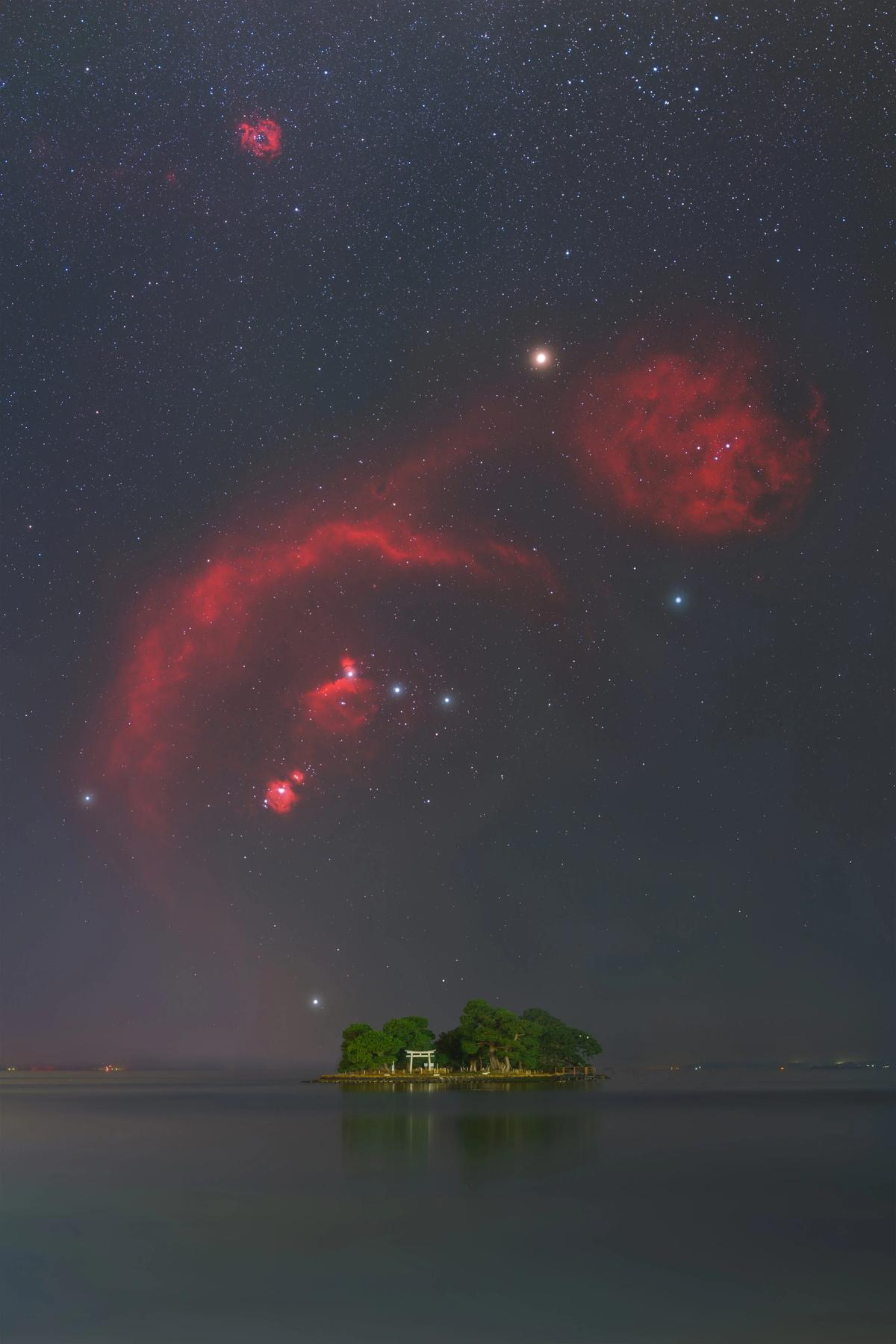
Why It Matters
The image demonstrates how advanced amateur equipment and techniques can reveal nebular structures typically reserved for professional observatories, expanding public engagement with deep‑sky astronomy.
Key Takeaways
- •Orion’s outline captured from Yomegashima Island, Japan
- •Hα filter highlighted faint Barnard’s Loop emission
- •Sony mirrorless camera with 50 mm f/1.2 lens used
- •2.2 hours exposure at ISO 3200 for hydrogen line
- •Image showcases deep‑sky techniques for amateur astronomers
Pulse Analysis
Orion’s silhouette is one of the most recognizable constellations in the night sky, yet its surrounding nebulosity remains hidden to the naked eye. Barnard’s Loop, a vast arc of ionized hydrogen stretching over 10 degrees, is a prime example of diffuse emission that only deep‑exposure imaging can capture. By positioning his camera on Yomegashima Island, Peng leveraged the dark skies over Lake Shinji to isolate the faint glow, turning a familiar celestial pattern into a laboratory for visualizing interstellar gas.
Peng’s setup combined a Sony mirrorless body with a 50 mm f/1.2 prime lens, a configuration prized for its wide aperture and sharp corner performance. He divided the total exposure into 30‑second subframes, accumulating nearly three hours of data. The majority—2.2 hours—was captured through a hydrogen‑alpha (Hα) filter at ISO 3200, isolating the specific 656 nm emission line that defines Barnard’s Loop. The remaining frames employed a Lee No. 1 broadband filter at ISO 200 to preserve Orion’s stellar colors while suppressing light pollution. Post‑processing stitched the subframes, calibrated the background, and enhanced contrast, yielding a final image that balances scientific fidelity with artistic impact.
The photograph underscores a growing trend where skilled amateurs bridge the gap between hobbyist imaging and professional research. By documenting faint hydrogen structures with consumer‑grade gear, Peng provides a template for citizen scientists seeking to contribute data to nebular surveys. Moreover, the visual appeal of the Orion‑Barnard composition fuels public interest in astrophysics, encouraging outreach programs and educational initiatives. As sensor technology and filter designs continue to improve, similar projects will likely generate increasingly detailed maps of the Milky Way’s diffuse components, enriching both scientific databases and popular appreciation.
The Hunter looms
0
Comments
Want to join the conversation?
Loading comments...