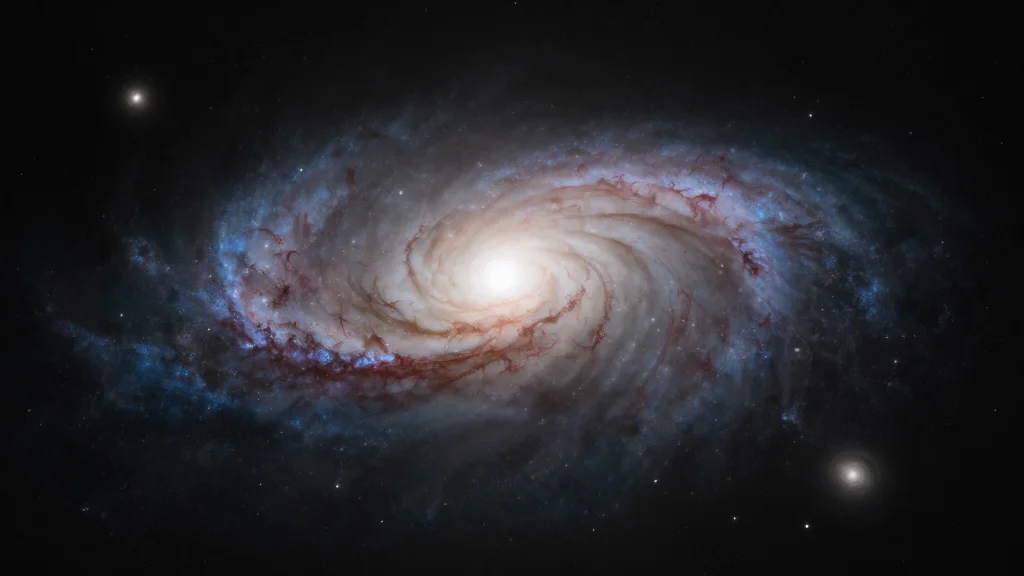
The Local Universe’s Expansion Rate Is Clearer Than Ever, but Still Doesn’t Add Up
Companies Mentioned

NOIRLab
Why It Matters
The persistent Hubble tension challenges the standard ΛCDM model, potentially signaling new physics or unrecognized systematic errors, and influences cosmological forecasts and funding priorities.
Key Takeaways
- •Local Hubble constant measured at 73.2 ± 0.8 km/s/Mpc
- •Discrepancy with Planck’s CMB value exceeds 4 sigma
- •Independent methods (lensing, megamasers) corroborate higher local rate
- •Tension may imply dark energy evolution or extra relativistic particles
- •Precision now limited by systematic, not statistical, uncertainties
Pulse Analysis
The latest round of local distance‑ladder measurements has pushed the precision of the Hubble constant to unprecedented levels. By combining Cepheid‑calibrated Type Ia supernovae with Gaia parallaxes and the Nearby Supernova Factory’s spectrophotometric data, astronomers have narrowed the uncertainty to less than one percent. This achievement not only refines the cosmic distance scale but also sharpens the contrast with the value derived from the Planck satellite’s observations of the early universe, which sit around 67 km s⁻¹ Mpc⁻¹.
Why does the gap matter? In the standard ΛCDM framework, the expansion rate should be consistent across epochs, linking early‑universe physics to late‑time observations. The growing 4‑sigma tension suggests that either unknown systematic errors persist in one or more measurement techniques, or that the cosmological model is incomplete. Theoretical proposals range from early dark energy episodes to additional light particles that alter the sound horizon. Each scenario carries distinct predictions for upcoming surveys like the Vera C. Rubin Observatory and the Euclid mission, making the resolution of this tension a high‑stakes priority for the field.
The community is responding with a multi‑pronged strategy. Strong‑lensing time‑delay studies, such as those from the H0LiCOW collaboration, now report values aligning with the local ladder, while megamaser distance measurements provide an independent geometric check. Simultaneously, next‑generation CMB experiments aim to reduce their own error bars. As these independent avenues converge, the next few years could either cement the case for new physics or reveal subtle biases, reshaping our understanding of cosmic expansion.
The Local Universe’s Expansion Rate Is Clearer Than Ever, but Still Doesn’t Add Up
Comments
Want to join the conversation?
Loading comments...