Why It Matters
If correct, the findings reveal how captured moons can fundamentally reshape a planet’s climate axis, informing models of planetary evolution both in our Solar System and on exoplanets.
Key Takeaways
- •Triton's retrograde capture likely caused Neptune's 28° tilt.
- •Tidal evolution can shift planetary obliquities over billions years.
- •Simulations show up to 50° tilt possible, 25% exceed 20°.
- •Triton may breach Roche limit in ~3.6 billion years.
Pulse Analysis
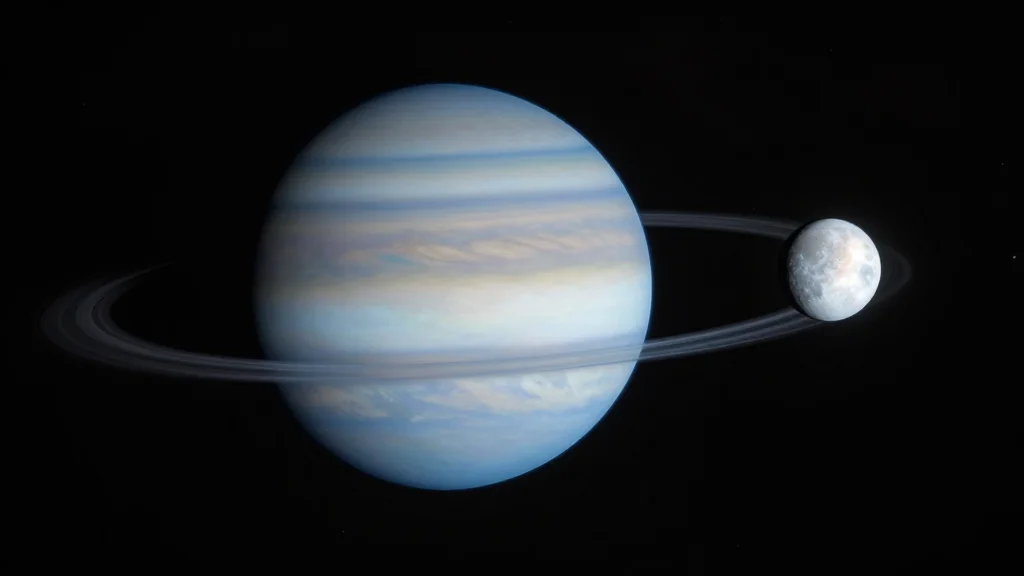
Neptune’s 28‑degree axial tilt has long puzzled astronomers, especially because the ice giant’s distant, frigid environment offers few clues. A new study by Rodney Gomes of São Paulo State University argues that the tilt is a direct consequence of Triton, Neptune’s massive retrograde moon, being captured from the Kuiper Belt billions of years ago. The research, posted on arXiv, links the moon’s unusual orbit to a planetary wobble that gradually reoriented Neptune’s spin axis. This hypothesis reframes the moon not merely as a satellite but as a planetary sculptor.
The mechanism hinges on tidal evolution: as Triton’s eccentric, inclined orbit decayed, its gravitational torque resonated with the solar‑system frequency known as s₈, effectively nudging Neptune’s spin like a spinning top. Gomes’ numerical simulations reveal that such resonant interactions can generate obliquities exceeding 50 degrees, and in roughly one‑quarter of runs the tilt surpasses 20 degrees—enough to match the observed 28‑degree lean. These results demonstrate that moon‑planet tidal coupling can reshape a planet’s axial orientation over timescales of hundreds of millions of years.
Looking ahead, Triton’s inward spiral will continue; models predict it will cross Neptune’s Roche limit in about 3.6 billion years, either colliding with the planet or spawning a new ring system. Beyond our Solar System, the study provides a template for interpreting tilted exoplanets that host massive moons or captured bodies. Understanding such dynamical histories is crucial for assessing planetary climate stability, habitability prospects, and the long‑term evolution of planetary systems.
The moon that tipped a planet
Comments
Want to join the conversation?
Loading comments...