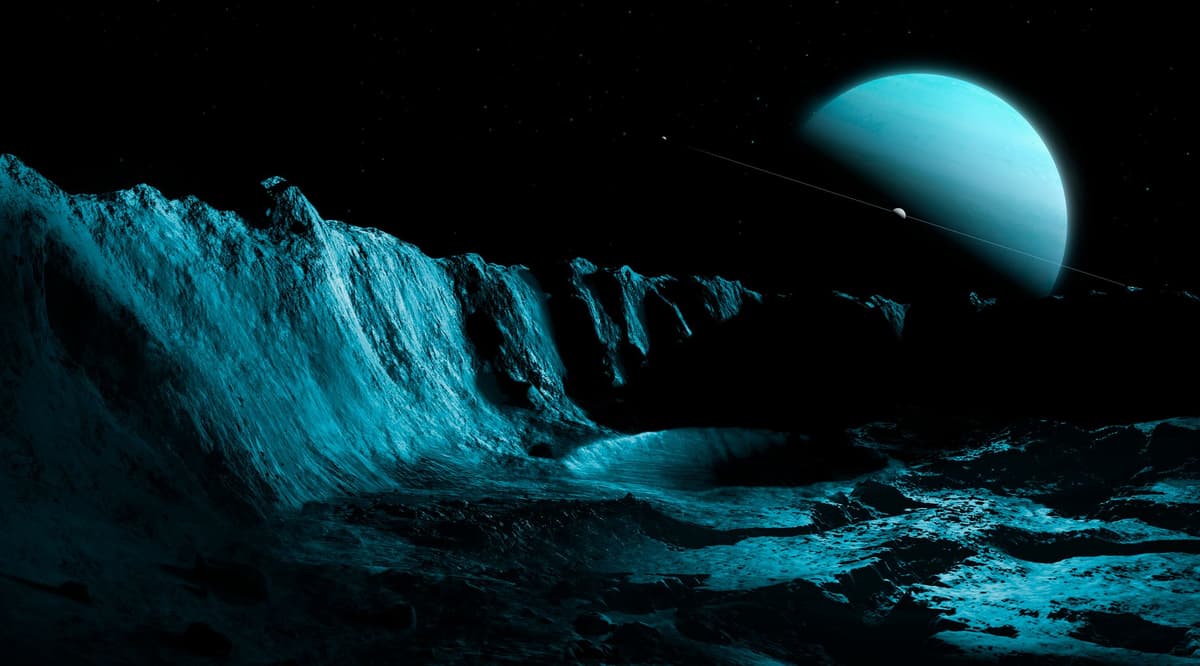
The Moons of Uranus May Hold the Key to Finding Missing Planets
Why It Matters
If the findings are correct, they provide indirect evidence for now‑lost ice giants, reshaping theories of planetary migration and the chaotic early history of our solar system. This insight could refine models used to interpret exoplanet system formation.
Key Takeaways
- •Uranus' moons destabilized twice: tilt impact and giant-planet encounters
- •Miranda likely formed from debris of a shattered larger moon
- •122 simulations show 85% chance of Uranian moon system collapse
- •Ejected ice giants could explain current eccentricities of Jupiter and Saturn
Pulse Analysis
The chaotic early solar system is a hot topic among planetary scientists, and the latest Icarus paper adds a compelling piece to the puzzle. By running 122 high‑resolution simulations of planetary migration, researchers showed that the survival of Uranus’ moons hinges on a brief window when additional ice giants roamed the outer solar system before being flung into interstellar space. This "missing‑planets" scenario not only accounts for the odd orbital tilt of Uranus but also explains the fragmented nature of its smallest major moon, Miranda, which appears to be the remnants of a larger body shattered during the upheaval.
Understanding how giant planets interact during periods of instability has broader implications for exoplanet studies. Many observed exoplanetary systems display tightly packed, eccentric orbits that hint at past dynamical reshuffling. The Uranus‑moon evidence offers a solar‑system analog, suggesting that ejected planets may be a common outcome of early system evolution. By linking observable satellite characteristics to unseen planetary histories, astronomers gain a new diagnostic tool for reconstructing the formation pathways of distant worlds.
The findings also challenge traditional models that assume the four gas giants formed in situ and remained largely unchanged. If one or two Neptune‑sized planets were indeed expelled, the resulting gravitational waves would have rippled through the nascent Kuiper Belt, influencing the distribution of small bodies we see today. This perspective encourages a reevaluation of the solar system’s architecture, prompting future missions to Uranus and its moons to search for further clues—such as surface composition anomalies or subsurface oceans—that could confirm the violent past hinted at by Miranda’s patchwork terrain.
The Moons of Uranus May Hold the Key to Finding Missing Planets
Comments
Want to join the conversation?
Loading comments...