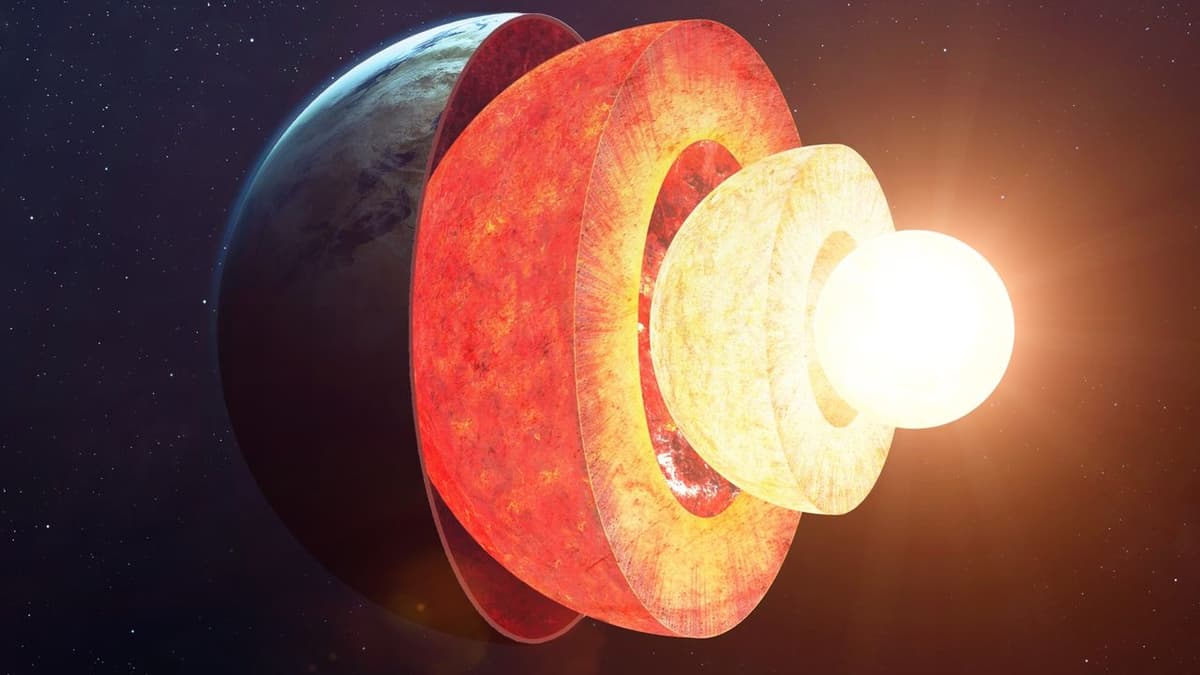
The Most Common Type of Planet in the Galaxy May Not Look Anything Like Earth on the Inside
Why It Matters
Understanding interior structures reshapes estimates of planet evolution, atmospheric retention, and habitability, impacting how astronomers classify the most common worlds in the galaxy.
Key Takeaways
- •Sub‑Neptunes with >1% hydrogen form fully mixed interior fluid.
- •Mixed interiors naturally reproduce the exoplanet radius gap.
- •Hydrogen exsolution slows contraction, making young sub‑Neptunes appear puffier.
- •JWST can test interior mixing by measuring radii of very young planets.
- •Traditional core‑mantle models may apply only to rare Earth‑like planets.
Pulse Analysis
The paper’s core insight is that at temperatures above roughly 4,000 K hydrogen, molten silicate and iron become fully miscible. Rather than sinking into a dense metallic core, these materials blend into a single, churned fluid throughout most of the planet’s interior. This overturns the textbook picture of a layered planet and forces a re‑examination of how sub‑Neptunes acquire and retain their gaseous envelopes. By linking laboratory high‑pressure physics with exoplanet demographics, the authors provide a physically plausible mechanism for interior mixing that had previously been ignored.
Observationally, the miscibility model offers a natural explanation for two long‑standing puzzles: the radius gap between super‑Earths and sub‑Neptunes, and the systematic increase in planet size with orbital period. If hydrogen is trapped in the interior and slowly exsolves as the planet cools, the outer envelope remains puffier for hundreds of millions of years. This delayed contraction matches the dearth of intermediate‑sized planets seen by Kepler and the JWST‑derived radius distribution of young systems. Upcoming transit surveys targeting stars only tens of millions of years old could directly measure the predicted excess radii, providing a decisive test of the theory.
Beyond the immediate exoplanet community, the findings ripple through planetary formation and habitability studies. A mixed interior alters heat transport, magnetic field generation, and atmospheric escape rates, all of which influence a planet’s long‑term climate stability. If Earth‑like, core‑centric interiors are the exception, models of volatile delivery and surface conditions may need revision. Future high‑pressure experiments and refined interior simulations will be crucial, but the current framework already reshapes how scientists prioritize targets for detailed atmospheric characterization with JWST and next‑generation observatories.
The most common type of planet in the galaxy may not look anything like Earth on the inside
Comments
Want to join the conversation?
Loading comments...