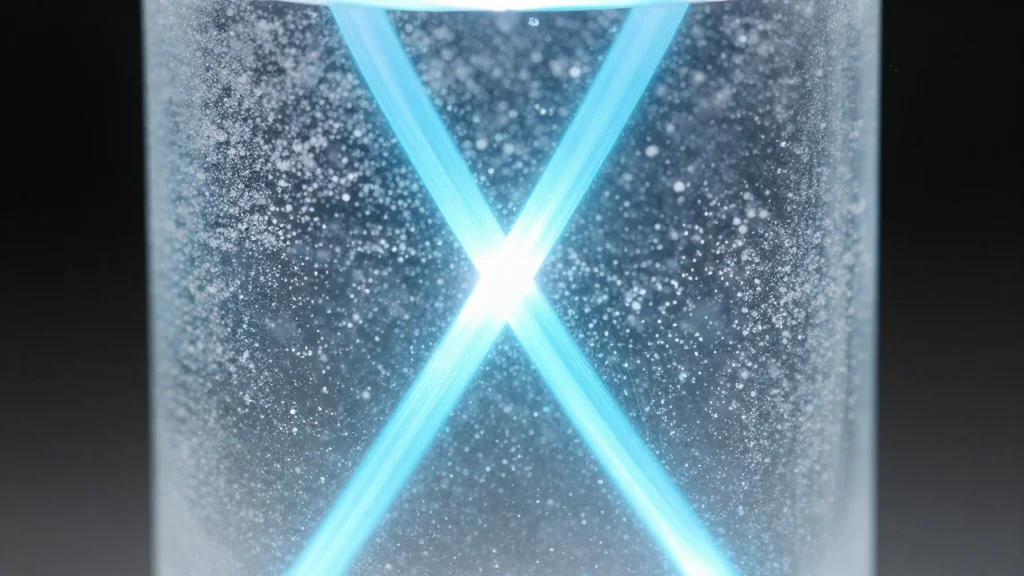
The Quantum Key to Seeing Through Chaos
Why It Matters
Selective transmission of quantum information through opaque scattering environments could revolutionize secure optical links and biomedical imaging, where conventional wavefront shaping fails. It also points to new hardware‑based strategies for tackling hard optimization problems.
Key Takeaways
- •Entangled photon pairs transmit images through scattering media while classical light fails
- •Spatial light modulator phase mask preserves quantum correlations after disorder
- •Technique turns complex media into programmable filters for quantum information
- •Potential applications include secure communications and deep‑tissue imaging
Pulse Analysis
In optical systems, scattering media such as biological tissue, atmospheric turbulence, or multimode fibers scramble incoming light, erasing spatial information and rendering conventional imaging impossible. Traditional wavefront‑shaping techniques mitigate this by measuring and inverting the scattering matrix, but they rely on classical light and often demand intensive computation. Quantum optics introduces a fundamentally different resource: entangled photon pairs whose correlations survive transformations that destroy classical coherence. Leveraging this “double linearity,” researchers can access transmission pathways that are invisible to ordinary photons, offering a new dimension of control over disordered environments.
The Paris‑Glasgow team implemented the concept by programming a spatial light modulator with a phase mask tuned to preserve the joint spatial correlations of entangled photons after they traverse a diffuser. While classical illumination subjected to the same mask loses its image, the quantum‑correlated pair emerges with the original pattern intact, effectively turning the random medium into a selective quantum filter. This physical discrimination between classical and quantum channels promises ultra‑secure communication links, because eavesdroppers using conventional light cannot retrieve the encoded information.
Beyond cryptography, the method could reshape biomedical imaging by allowing clinicians to view structures hidden deep within scattering tissue without resorting to computationally heavy inversion algorithms. Moreover, the underlying optimization—analogous to minimizing a multi‑spin Hamiltonian—suggests that similar quantum‑enhanced hardware may tackle classes of NP‑hard problems more efficiently than classical processors. As quantum photonic platforms mature, integrating entanglement‑driven wavefront shaping into fiber‑optic networks and endoscopic devices may become a practical route to high‑resolution, low‑noise imaging and robust quantum information transfer.
The quantum key to seeing through chaos
Comments
Want to join the conversation?
Loading comments...