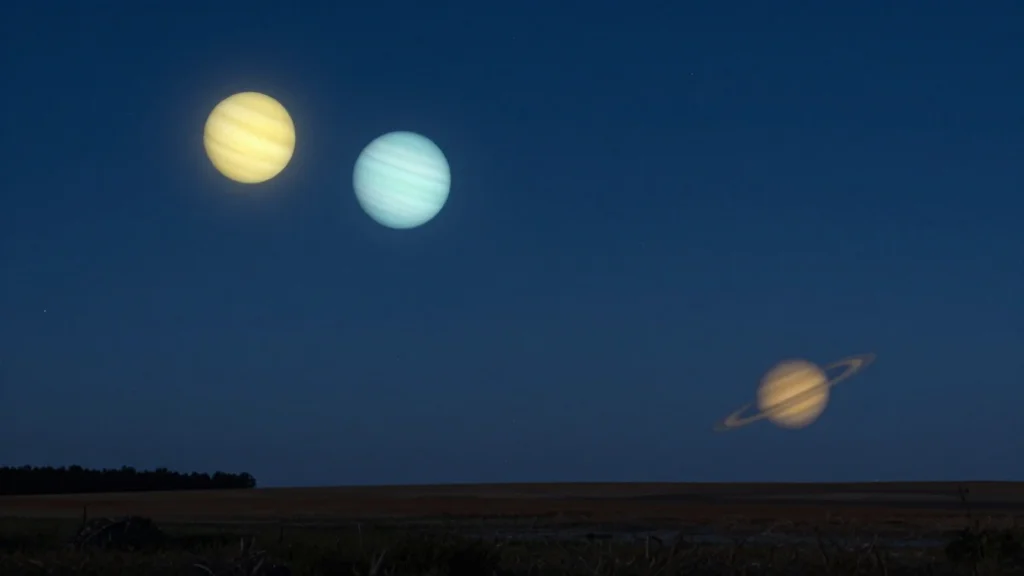
The Sky This Week From April 24 to May 1: Saturn Reappearing
Why It Matters
The events provide rare, low‑light observing windows that boost amateur engagement and drive demand for optical gear, while the Gamma Cas discovery advances our understanding of high‑energy processes in Be‑type star systems.
Key Takeaways
- •Venus and Uranus within 1.5° for easy dual‑planet viewing
- •Regulus occulted by Moon, visible across eastern U.S. on April 25
- •Gamma Cas X‑rays traced to magnetic white‑dwarf companion
- •Comet 10P/Tempel 2 brightens to magnitude 11 in pre‑dawn sky
- •Saturn rises before sunrise, magnitude 0.9, ahead of Full May Moon
Pulse Analysis
Astronomy enthusiasts have a full week of high‑impact targets, from planetary pairings to deep‑sky phenomena. On Friday, Venus shines at magnitude ‑3.9 and serves as a beacon to locate the faint, bluish‑gray disk of Uranus just 1.5° away, a setup that many backyard telescopes can capture. The following night, the Moon’s path across Regulus offers a dramatic occultation visible from the eastern United States, while Jupiter’s moons perform a choreography of eclipses and positional swaps that reward patient observers with multiple moon‑watching sessions. By the weekend, Saturn climbs above the eastern horizon just before sunrise, its rings visible despite low altitude, and the Full May Flower Moon crowns the week, setting the stage for a rare Blue Moon at month’s end.
Beyond visual appeal, the week’s scientific highlight centers on Gamma Cassiopeiae, a classic Be star whose intense X‑ray output has long puzzled astronomers. Recent high‑precision spectroscopy confirms that the X‑rays originate not from the massive B‑type primary but from a magnetic white‑dwarf companion accreting material from the star’s circumstellar disk. This finding refines models of mass transfer in binary systems and underscores the role of magnetic fields in shaping high‑energy emissions, offering a fresh data point for stellar evolution theories.
These celestial events translate into tangible market dynamics. Peaks in public interest drive traffic to astronomy apps, star‑mapping services, and e‑commerce platforms selling telescopes, eyepieces, and filters. Retailers often see a sales lift of 15‑20% during weeks featuring prominent planets or comet appearances, while educational institutions leverage the timing for outreach programs and citizen‑science projects. As social media amplifies nightly skywatching tips, the convergence of compelling sky events and accessible technology continues to expand the amateur astronomy community and its economic footprint.
The Sky This Week from April 24 to May 1: Saturn reappearing
Comments
Want to join the conversation?
Loading comments...