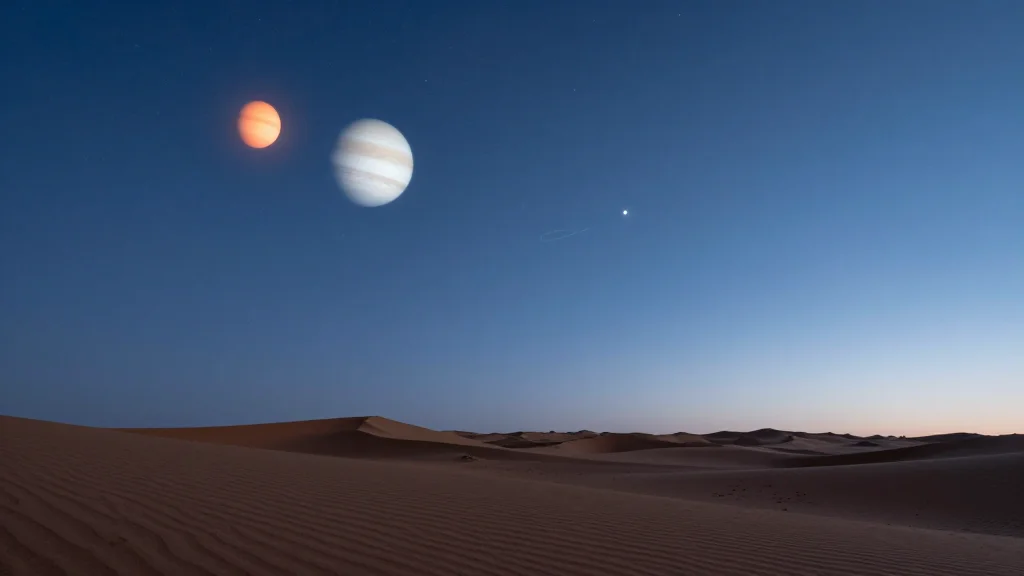
The Sky This Week From June 5 to 12: Jupiter and Venus Meet
Why It Matters
The planetary alignment provides a high‑visibility showcase for amateur astronomers, driving public interest and supporting outreach programs, while the deep‑sky highlights enrich seasonal observing calendars for clubs and educators.
Key Takeaways
- •Venus and Jupiter converge to 1.6° separation on June 8‑9
- •Io transits Jupiter, visible from Central US around 10 PM CDT
- •Globular cluster M5 shines at magnitude 5.7, visible to naked eye
- •Sunflower Galaxy M63 offers spiral view for small telescopes
- •NGC 188, the Polarissima Cluster, lies near Polaris at 5,000 ly
Pulse Analysis
The June 8‑9 Venus‑Jupiter conjunction is the week’s headline event, bringing two of the brightest planets within a telescopic field of view. Venus shines at magnitude –4.0, while Jupiter sits at –1.9, creating a striking contrast that can be captured with binoculars or a modest telescope. Central‑time observers have a bonus: Io’s shadow will cross Jupiter’s disk just after 10 PM CDT, offering a dynamic glimpse of the Galilean moons in motion. Timing the view for an hour after sunset maximizes altitude and minimizes atmospheric distortion.
Beyond the planets, the guide spotlights several deep‑sky treasures that are especially rewarding for backyard observers. Globular cluster M5, at magnitude 5.7, is bright enough to be seen without optics under dark skies and reveals a dense core and surrounding star streams in larger scopes. The Sunflower Galaxy (M63) presents a compact nucleus and faint spiral arms, ideal for 4‑ to 6‑inch telescopes. Meanwhile, NGC 188, dubbed the Polarissima Cluster, sits just 4° southeast of Polaris, offering a high‑latitude target that showcases an ancient open cluster at roughly 5,000 light‑years distance.
These events arrive at a pivotal point in the summer sky, when the Milky Way arches high and the constellations of the zodiac are well‑placed for evening observation. Planetarium programs and astronomy clubs can leverage the conjunction and accompanying deep‑sky objects to attract new participants, especially families seeking a tangible connection to the cosmos. By providing clear viewing windows, magnitude data, and contextual background, the weekly guide turns a routine night sky into a curated experience that fuels curiosity and reinforces the value of citizen science in the broader astronomical community.
The Sky This Week from June 5 to 12: Jupiter and Venus meet
Comments
Want to join the conversation?
Loading comments...