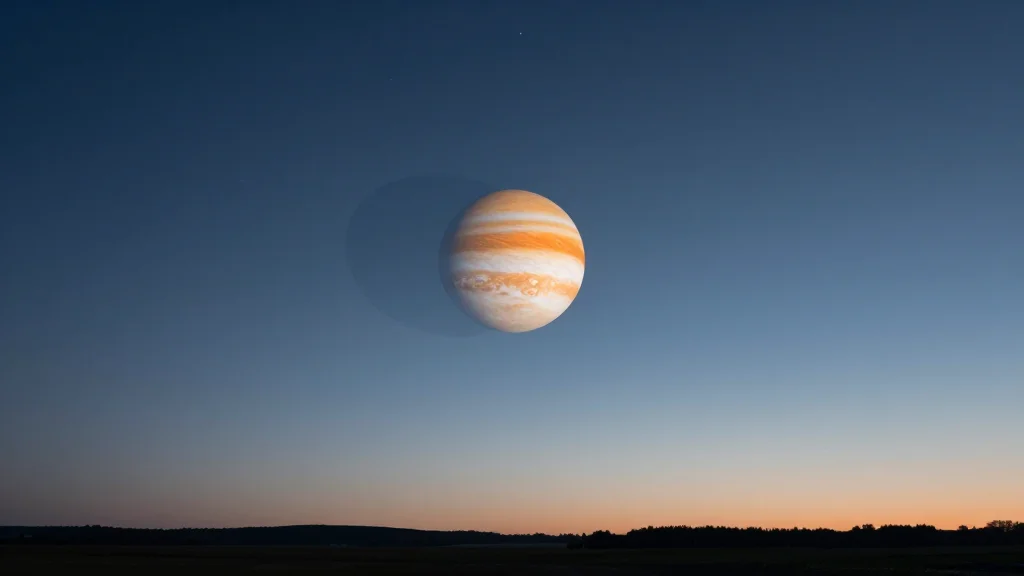
The Sky Today on Friday, April 10: Ganymede Shadow Crossing
Why It Matters
The event provides a unique, low‑cost observing opportunity for amateur astronomers and reinforces public engagement with planetary science, while Tempel 2 adds a cometary target for continued skywatching.
Key Takeaways
- •Ganymede’s shadow visible across western two‑thirds of U.S. at 12:57 A.M. CDT.
- •Transit lasts 8‑10 minutes to appear, spans over three hours across Jupiter.
- •Jupiter sets while shadow still crossing, ending before local sunrise.
- •Comet Tempel 2 rises around 1 A.M., 12th magnitude, near α Scuti.
- •Best viewed with moderate telescope; comet brightens toward summer.
Pulse Analysis
Shadow transits of Jupiter’s Galilean moons are infrequent spectacles that draw both seasoned observers and newcomers to the night sky. Ganymede, the largest moon, casts a sizable silhouette that drifts across the planet’s swirling bands, revealing subtle atmospheric dynamics and offering a real‑time demonstration of orbital mechanics. This particular crossing is noteworthy because it occurs while Jupiter is low on the western horizon, allowing a broad swath of the United States to witness the event before the planet disappears below the horizon. For educators, the transit serves as a vivid illustration of how moons interact with their host planets, reinforcing concepts taught in introductory astronomy courses.
For the practical astronomer, timing and location are critical. The shadow first becomes discernible at 12:57 A.M. CDT, forming a dark notch on Jupiter’s southeastern limb that reaches full visibility within eight to ten minutes. Because Jupiter sets before sunrise, observers have a limited window—roughly three hours—to track the shadow’s progression across the disk. A modest 4‑inch (10 cm) telescope or even high‑power binoculars can capture the dark silhouette, but a stable mount and dark‑adapted eyes improve contrast. Meanwhile, comet Tempel 2, now 12th magnitude, rises shortly after 1 A.M. and sits just 2° southwest of α Scuti, making it an excellent target for those with larger apertures seeking a faint, moving object to complement the planetary show.
Beyond the immediate visual appeal, these events underscore the accessibility of modern skywatching. With free online ephemerides and smartphone apps, hobbyists can plan observations without costly equipment. The Ganymede shadow and Tempel 2’s summer approach also hint at a busy astronomical calendar ahead, including upcoming Europa eclipses and the comet’s gradual brightening toward a potential naked‑eye display later in the year. Such phenomena keep the public engaged, inspire citizen‑science projects, and sustain interest in planetary and cometary research, reinforcing the broader value of amateur contributions to the scientific community.
The Sky Today on Friday, April 10: Ganymede shadow crossing
Comments
Want to join the conversation?
Loading comments...