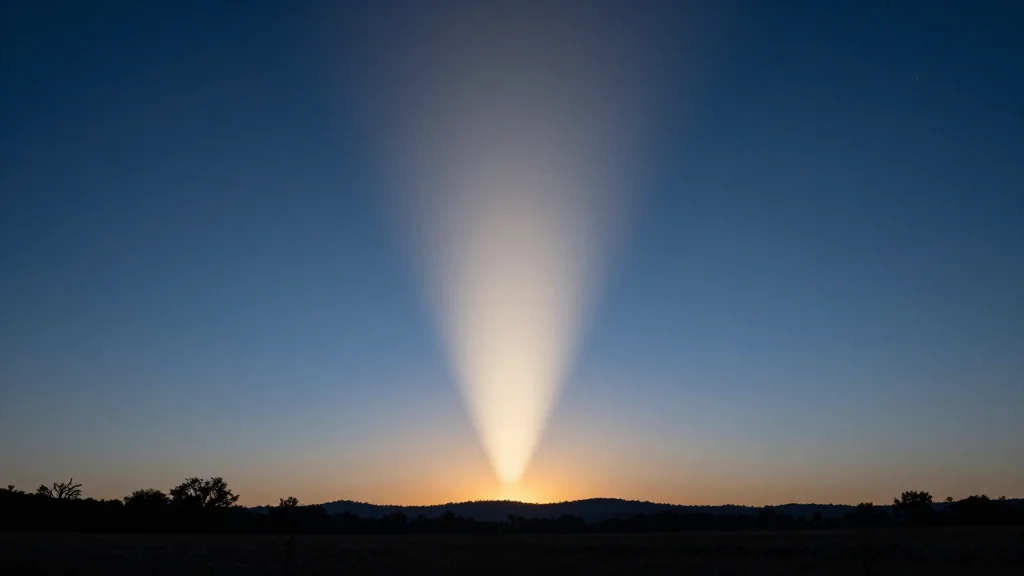
The Sky Today on Friday, April 17: Perfect Setup for the Zodiacal Light
Why It Matters
The dark‑sky window lets amateur and professional astronomers observe a subtle solar‑system phenomenon, boosting public engagement with night‑sky science and underscoring how lunar phases affect skywatching.
Key Takeaways
- •New Moon at 7:52 AM EDT creates dark skies for viewing.
- •Zodiacal light results from sunlight scattering off interplanetary dust.
- •Look west after twilight; ecliptic runs through Taurus to Cancer.
- •Long‑exposure photos can reveal the faint glow even if unseen.
- •Ganymede transits Jupiter on April 16 provides another sky event.
Pulse Analysis
The zodiacal light is one of the night sky’s most elusive displays, produced when sunlight reflects off a thin veil of interplanetary dust left by comets. This dust settles into the plane of the solar system, forming a broad, triangular glow that follows the ecliptic. While astronomers have studied the phenomenon for decades to understand dust dynamics and solar radiation pressure, it remains a visual treat for anyone able to see it, linking casual observers to the same particles that orbit alongside Earth.
April 17 offers a textbook case for viewing the zodiacal light. With the New Moon rising at 7:52 AM EDT, the sky stays dark throughout the night, eliminating the usual lunar glare that drowns out faint celestial glows. After sunset at 7:41 PM, the ecliptic climbs leftward across the western horizon, threading through Taurus, Gemini, and into Cancer. As twilight fades, the lingering glow should become discernible as a diffuse band widening toward Taurus and tapering toward Gemini or Cancer. The same week, Ganymede’s transit across Jupiter on April 16 adds another compelling target for skywatchers.
For those who struggle to see the light with the naked eye, a simple long‑exposure shot can reveal its structure. Using a tripod, set a DSLR or even a modern smartphone to a high ISO and a 15‑30‑second exposure, aiming the lens low in the west. The resulting image will capture the faint cone against the dark sky, providing both proof of observation and a shareable piece of astrophotography. Events like this underscore the value of preserving dark‑sky sites; as light pollution expands, opportunities to witness subtle phenomena such as the zodiacal light become increasingly rare, making each clear night a valuable window into our solar system’s dusty environment.
The Sky Today on Friday, April 17: Perfect setup for the zodiacal light
Comments
Want to join the conversation?
Loading comments...