The Sky Today on Friday, March 6: Io’s Turn to Transit
•March 6, 2026
0
Why It Matters
The transit provides a low‑cost, high‑visibility opportunity for sky‑watchers to engage with planetary science, driving interest in astronomy equipment and educational outreach. It also supplies real‑time data that can aid professional studies of Jupiter’s atmosphere and moon dynamics.
Key Takeaways
- •Io transits Jupiter at midnight EST March 6.
- •Transit lasts ~20 minutes; shadow follows an hour.
- •Visible from East Coast, bright in Gemini constellation.
- •Ideal timing for amateur telescope observations.
- •Shows Io’s fast orbital speed versus Ganymede.
Pulse Analysis
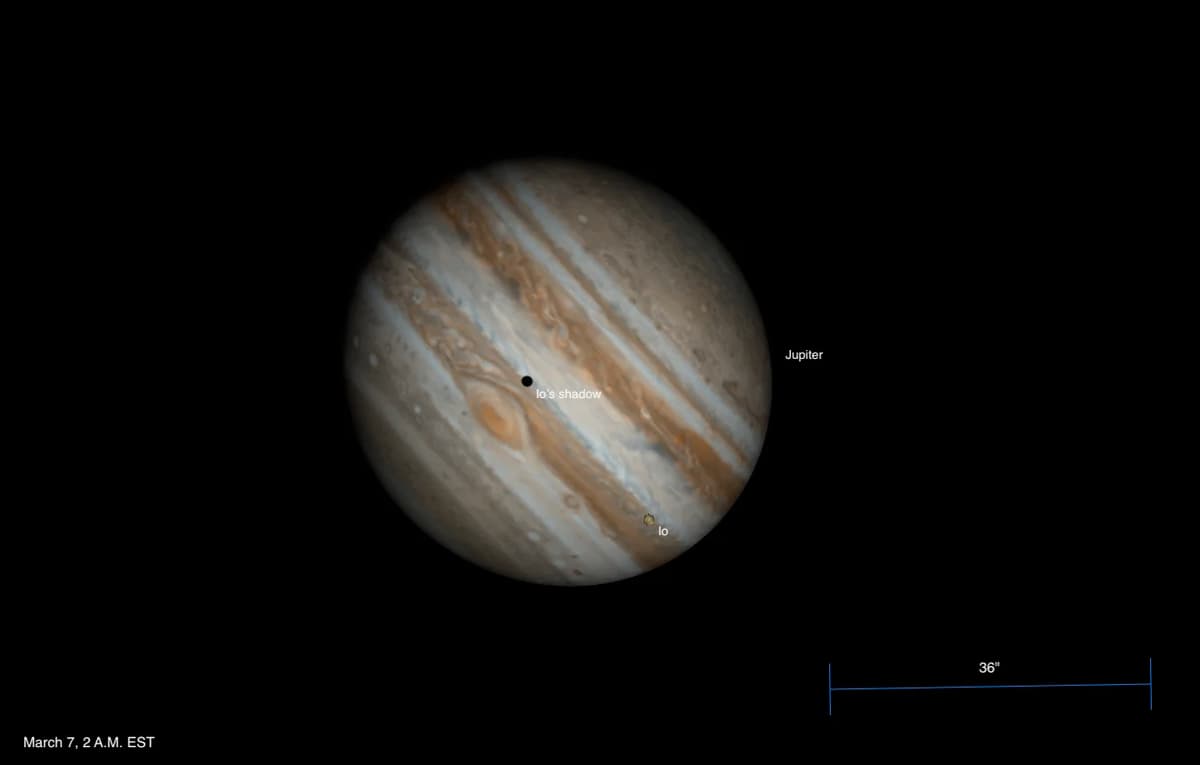
The night of March 6‑7, 2026 offers a rare visual of Io slipping across Jupiter’s glowing disk, an event that amateur astronomers can capture with modest equipment. Beginning at midnight Eastern Standard Time, the Galilean moon moves from the southeastern limb to the western edge in just under twenty minutes, while its dark silhouette lags behind, completing a full crossing an hour later. Because Jupiter sits high in the western sky over the East Coast, the transit is visible to the naked eye as a bright point in Gemini, making it an accessible sky‑watching highlight for hobbyists and educators alike.
Io’s swift transit underscores the moon’s tight 1.77‑day orbit, a stark contrast to Ganymede’s slower passage observed earlier this month. The moon’s rapid motion produces a compact shadow that sweeps across Jupiter’s cloud bands, offering a live demonstration of orbital dynamics and shadow geometry that can be measured with simple timing techniques. Professional observatories often use such events to refine models of Jupiter’s atmospheric circulation, while citizen scientists contribute valuable timing data to collaborative databases, enriching our collective understanding of the Jovian system.
The visibility of this transit translates into a tangible boost for the amateur‑telescope market, as retailers report spikes in sales of portable refractors and high‑magnification eyepieces ahead of the event. Astronomy clubs leverage the timing to host public viewing nights, driving community engagement and fostering STEM interest among students. Looking forward, the predictable schedule of Galilean moon transits provides a steady stream of content for streaming platforms and educational podcasts, creating new revenue streams for media outlets that specialize in space‑focused programming.
The Sky Today on Friday, March 6: Io’s turn to transit
0
Comments
Want to join the conversation?
Loading comments...