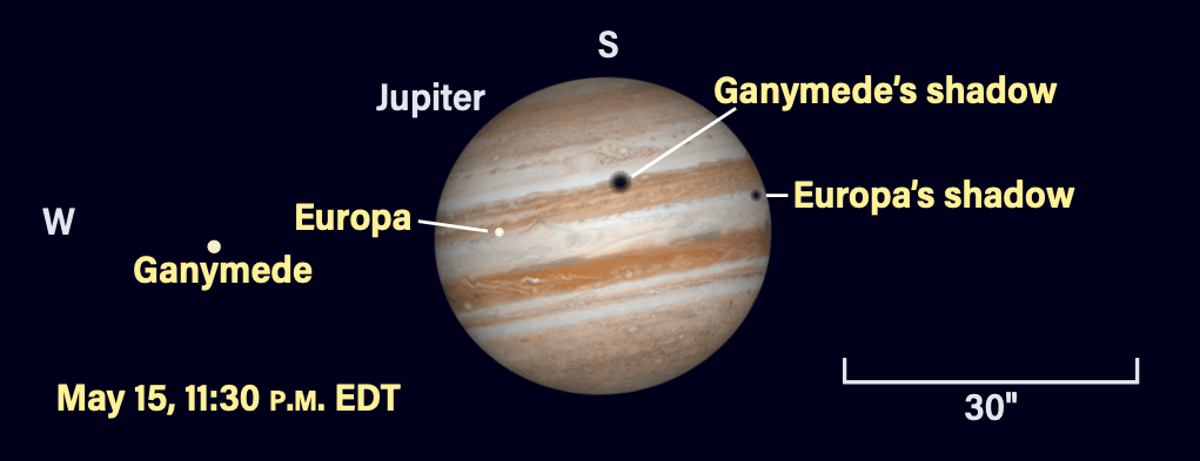
The Sky Today on Friday, May 15: A Double Shadow Transit at Jupiter
Why It Matters
The simultaneous shadows provide a striking visual for skywatchers and a practical demonstration of orbital mechanics, boosting public interest in planetary astronomy. For educators and amateur astronomers, the event offers a low‑cost, high‑impact opportunity to observe real‑time moon‑planet interactions.
Key Takeaways
- •Double shadow transit of Europa and Ganymede visible May 15.
- •Ganymede's shadow starts at 9:58 PM EDT, ends 11:26 PM MDT.
- •Europa's shadow appears 11:20 PM EDT, ends 11:12 PM PDT.
- •Event observable across U.S., best from Midwest to West Coast.
- •Io occulted by Jupiter; Callisto lies outside the field of view.
Pulse Analysis
The double‑shadow transit on May 15 marks one of the few occasions each decade when two Galilean moons cast overlapping silhouettes on Jupiter’s swirling atmosphere. Such alignments are governed by the precise orbital periods of Europa (3.55 days) and Ganymede (7.15 days), creating a predictable yet visually dramatic pattern that amateur astronomers cherish. Observers can track the shadows moving east‑to‑west, a real‑time illustration of celestial mechanics that textbooks often describe only in diagrams.
For sky‑watchers across the United States, timing and location are key. The event begins in the Midwest as darkness falls, with Ganymede’s larger shadow leading the show. By the time the eastern seaboard reaches full darkness, Europa’s smaller shadow joins, offering a layered view before Jupiter dips toward the horizon. No special equipment is required—binoculars or a modest telescope will reveal the dark silhouettes against the planet’s bands, while a smartphone app can help pinpoint the exact moments for each time zone.
Beyond its visual appeal, the transit provides a practical laboratory for studying Jupiter’s atmospheric dynamics. As the shadows traverse the cloud tops, subtle changes in brightness can be measured to infer wind speeds and cloud thickness. Historically, similar events have helped refine orbital models of the Galilean moons and calibrate spacecraft navigation. Looking ahead, the next comparable double‑shadow alignment won’t occur until 2034, making this May 15 spectacle a timely reminder of the ever‑moving dance of our solar system’s largest planet and its companions.
The Sky Today on Friday, May 15: A double shadow transit at Jupiter
Comments
Want to join the conversation?
Loading comments...