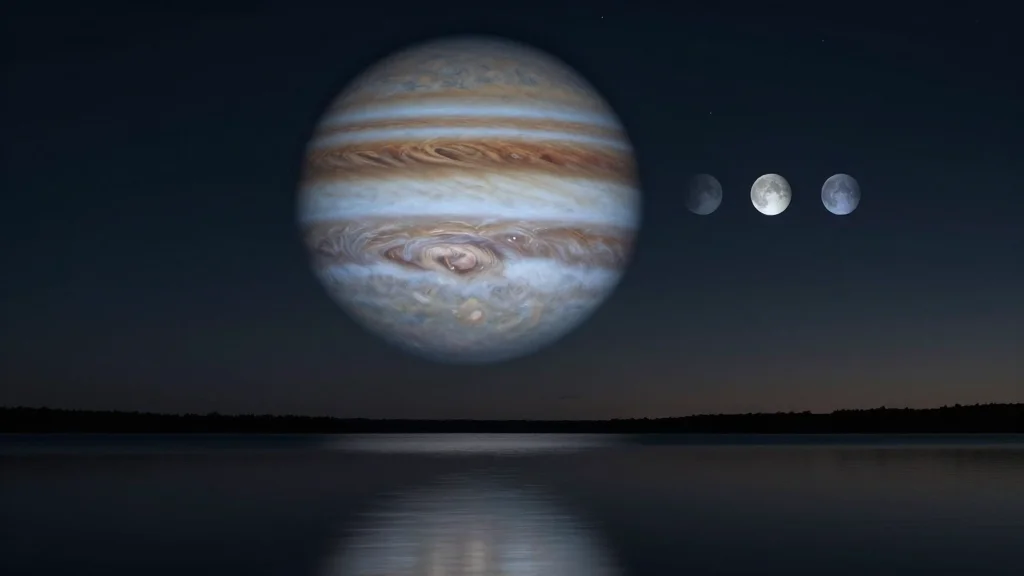
The Sky Today on Monday, April 13: Io and Europa Cross Paths
Why It Matters
The alignment offers a rare, low‑cost opportunity for amateur astronomers to study Jovian moon dynamics and reinforces public interest in planetary science, driving demand for backyard telescopes and educational programs.
Key Takeaways
- •Europa transits Jupiter at 11:42 PM EDT, lasting ~20 minutes
- •Io crosses 5″ north of Europa after midnight Central time
- •Io occulted by Jupiter at 1:15 AM CDT, then disappears
- •Ganymede and Callisto remain east of Jupiter throughout
- •Event visible across most of the U.S. with modest optics
Pulse Analysis
The April 13‑14 celestial showcase highlighted the intricate dance of Jupiter’s Galilean moons, offering a textbook example of orbital mechanics in real time. Europa’s shadow traced a dark silhouette across the gas giant’s swirling bands, providing a clear visual cue for observers tracking its 3.5‑day orbit. Meanwhile, Io’s rapid eastward motion brought it into a close conjunction with Europa, a configuration that occurs only a few times each year and is prized by both amateur and professional astronomers for refining positional data.
For sky‑watchers in the United States, the timing was especially favorable. Europa’s transit became visible just after local sunset in the eastern half of the country, while the central and western regions caught the brief Io‑Europa crossing shortly after midnight. Simple equipment—a 4‑inch refractor or a quality binocular set—was sufficient to spot the dark blot of Europa’s shadow and the faint glint of Io as it approached Jupiter’s limb. The event also underscored the importance of precise timing tools; noting the exact moments of ingress and egress helps improve orbital models used by space agencies planning future missions to the Jovian system.
Beyond the visual spectacle, such alignments have broader implications for the astronomy market and STEM outreach. Increased public interest during high‑profile events drives sales of telescopes, mounts, and astrophotography accessories, while schools and planetariums leverage the phenomenon to engage students with hands‑on lessons about gravity, resonance, and planetary formation. As the next generation of space telescopes prepares to study Europa’s subsurface ocean, ground‑based observations like this serve as a reminder that even modest backyard setups can contribute valuable data to the scientific community.
The Sky Today on Monday, April 13: Io and Europa cross paths
Comments
Want to join the conversation?
Loading comments...