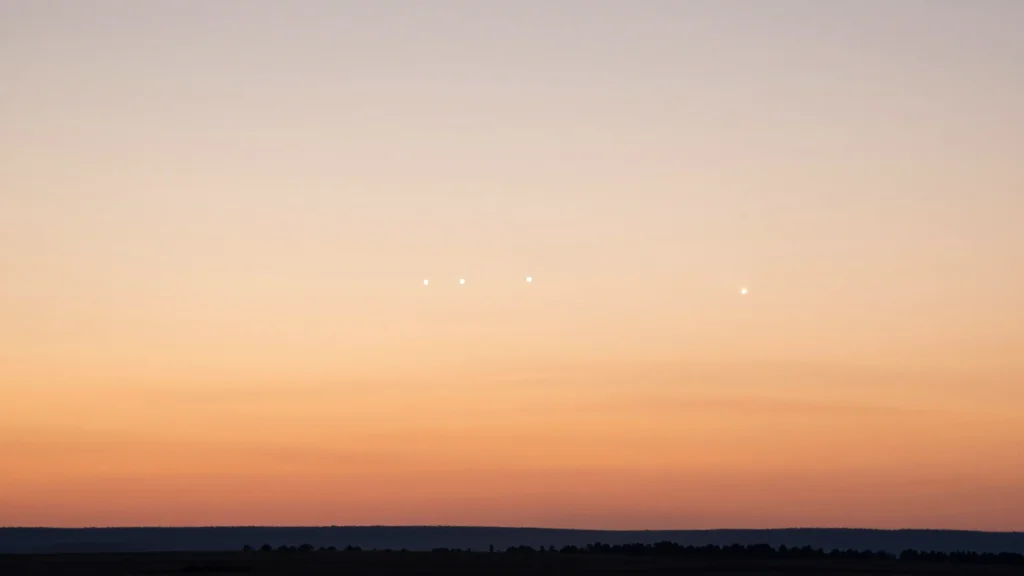
The Sky Today on Monday, April 20: A Trio of Predawn Planets
Why It Matters
The alignment provides a unique observing window that can boost amateur‑astronomy activity and drive demand for optical gear, while the comet’s visibility keeps public interest in near‑Earth objects high.
Key Takeaways
- •Mercury, Mars, Saturn align within 2° before sunrise on April 20, 2026
- •Mercury shines brightest at magnitude –0.2, visible with naked eye
- •Binoculars or small telescope needed to capture all three planets together
- •Comet C/2025 R3 remains just above 5th magnitude, visible in Pisces
- •The comet’s green tail results from diatomic carbon (C₂) emissions
Pulse Analysis
The early‑morning sky on April 20, 2026, presents an uncommon planetary conjunction that amateur astronomers eagerly await. Mercury, Mars and Saturn will cluster within a narrow two‑degree arc just before the Sun rises over the eastern horizon, making them observable in a single binocular view. Mercury’s –0.2 magnitude makes it the most prominent, while Saturn’s rings and Mars’ reddish hue add visual depth. Such tight groupings occur only a few times per decade, offering a natural laboratory for sky‑watchers to compare planetary motion and brightness.
Beyond the pure spectacle, this event has tangible market implications. Retailers of telescopes, binoculars and astrophotography accessories often see a sales spike ahead of notable celestial events, and the April 20 alignment is no exception. Local astronomy clubs and tour operators can capitalize on the timing by organizing pre‑sunrise viewing sessions, driving foot traffic to observatories and dark‑sky sites. The heightened demand for portable optics also benefits manufacturers, who may promote lightweight, high‑contrast models tailored for low‑light, horizon‑level viewing.
Meanwhile, comet C/2025 R3 (PanSTARRS) adds another layer of intrigue. Still brighter than 5th magnitude and trailing a vivid green tail caused by diatomic carbon emissions, the comet offers both visual appeal and scientific value. Researchers monitor its fading brightness to refine models of cometary outgassing and nucleus composition. For the broader public, the comet serves as a gateway to space science, encouraging casual observers to engage with astronomy apps and citizen‑science platforms. Together, the planetary trio and the lingering comet underscore how transient sky events can spark both commercial activity and educational outreach.
The Sky Today on Monday, April 20: A trio of predawn planets
Comments
Want to join the conversation?
Loading comments...