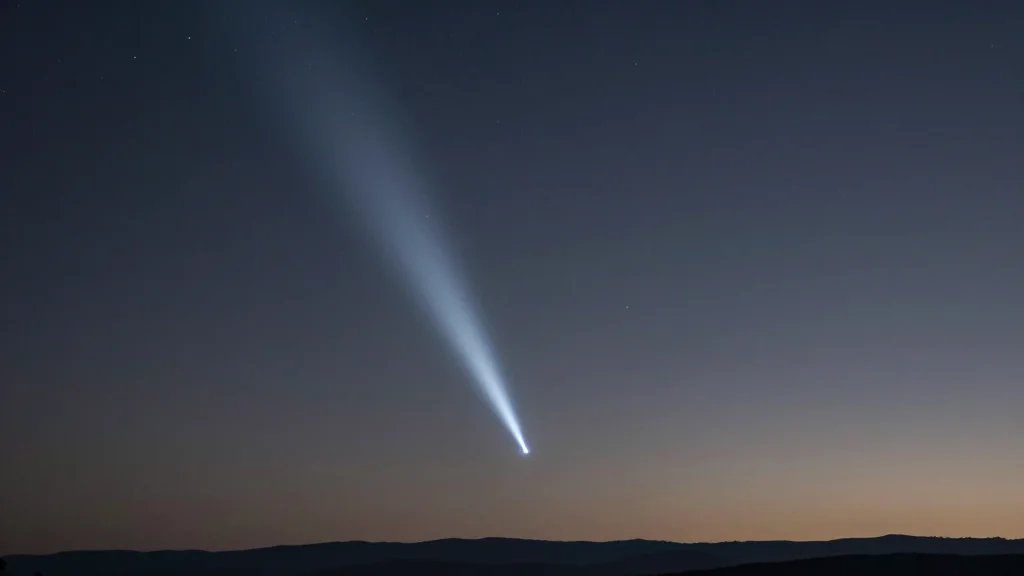
The Sky Today on Monday, April 27: Comet Tempel 2 and NGC 6712
Why It Matters
The alignment lets hobbyists compare a moving comet with a distant star cluster and witness rare Jovian moon events, deepening public engagement with observational astronomy.
Key Takeaways
- •Comet Tempel 2 reaches magnitude 11, visible near NGC 6712
- •Both comet and cluster fit within a single binocular field
- •Jupiter’s moon Ganymede emerges from occultation for West Coast observers
- •Europa transits Jupiter early April 28, visible after midnight
- •Jupiter sets around 1:30 A.M. local time across most U.S.
Pulse Analysis
Comet 10P Tempel 2, a periodic visitor returning every 5.5 years, entered a favorable viewing window this spring as it approached perihelion. Its modest brightening to magnitude 11 places it within reach of seasoned backyard observers, especially when it climbs to 35° high in the southeast sky before dawn. The comet’s trajectory through Scutum brings it within a few degrees of several deep‑sky objects, creating a natural laboratory for side‑by‑side comparisons of diffuse cometary comae and compact stellar assemblies.
NGC 6712, a globular cluster nestled in the constellation Scutum, shines at magnitude 8.2 and spans roughly seven arcminutes. Unlike the fleeting glow of a comet, the cluster’s dense core and surrounding halo remain static, offering a benchmark for assessing comet brightness profiles and tail morphology. For educators and amateur astronomers, pointing a telescope at both targets in quick succession illustrates the dynamic range of celestial phenomena—from a moving icy nucleus shedding dust to an ancient congregation of stars bound by gravity.
The late‑night drama on April 27‑28 featured Jupiter’s largest moon, Ganymede, slipping behind the planet in an occultation before re‑emerging for observers on the U.S. West Coast. Simultaneously, Europa began its transit across Jupiter’s disk, a rare alignment that provides a clear view of moon shadows and atmospheric features. Such events are prized by planetary observers because they refine orbital models and reveal subtle changes in Jupiter’s cloud bands. Timing the observations—Ganymede’s reappearance at 12:19 A.M. PDT and Europa’s ingress around 12:30 A.M. MDT—maximizes the scientific and visual payoff for anyone with a modest telescope.
The Sky Today on Monday, April 27: Comet Tempel 2 and NGC 6712
Comments
Want to join the conversation?
Loading comments...