The Sky Today on Monday, May 11: Egeria Moves Along
Why It Matters
The close encounter provides a practical demonstration of asteroid motion for amateur astronomers, reinforcing public interest in planetary science. Simultaneous lunar viewing highlights how lunar libration can reveal normally hidden features, enriching sky‑watching experiences.
Key Takeaways
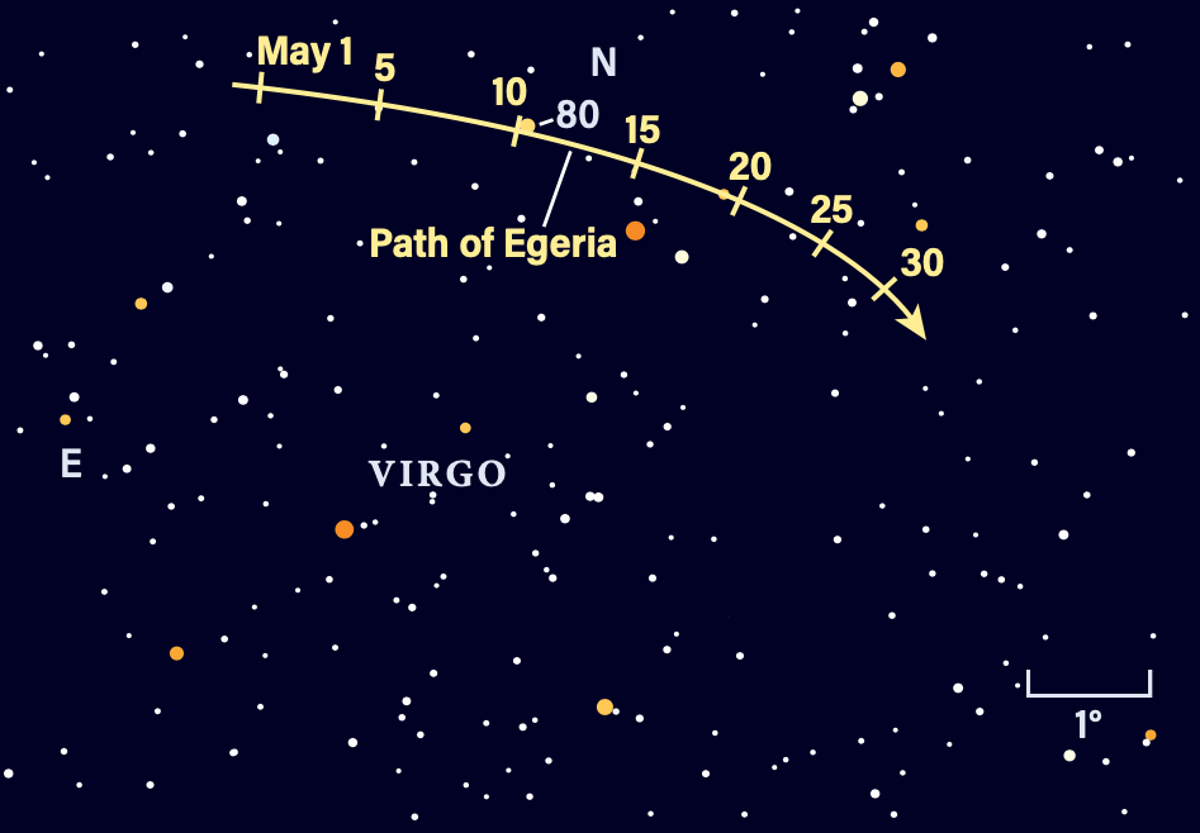
- •Egeria passes within 1° of 80 Virginis, magnitude 5.7, tonight.
- •Asteroid appears near Spica, 6° north‑northeast, visible after sunset.
- •Sketch or photograph now and repeat in 2‑3 hours to see drift.
- •Moon’s waning crescent shows 25% illumination; Schickard crater becomes more circular.
- •Libration on May 12 improves view of 212 km Schickard crater.
Pulse Analysis
Observing asteroid motion in real time is a cornerstone of citizen‑science astronomy. When a main‑belt object like 13 Egeria drifts close to a fixed star, amateurs can directly measure its proper motion, contributing data that refines orbital models and alerts professionals to any unexpected perturbations. Such visual experiments also demystify celestial mechanics for the public, turning a nightly sky into a laboratory where anyone with a modest telescope or even the naked eye can participate in scientific discovery.
Egeria’s May 11 encounter is noteworthy because the asteroid will skim just under a degree from 80 Virginis, a 5.7‑magnitude star that serves as a bright reference point. At roughly 10th magnitude, Egeria is faint but still discernible against the dark backdrop of Virgo when the sky is clear. By capturing a quick sketch or photo now and repeating the process a few hours later, observers can see the asteroid shift southwest, illustrating orbital dynamics without sophisticated equipment. This hands‑on approach reinforces the value of systematic sky‑watching and encourages a new generation of hobbyists to log observations that feed into global databases.
The same night, lunar enthusiasts gain a complementary spectacle: the Moon’s waning crescent reveals the 212‑kilometer Schickard crater more fully due to favorable libration. Libration— the Moon’s subtle wobble—occasionally brings limb‑adjacent features into better view, offering a natural laboratory for studying crater morphology and volcanic resurfacing. Highlighting both asteroid tracking and lunar libration in a single observing window underscores the interconnectedness of planetary science and the richness of the night sky for both casual stargazers and seasoned astronomers.
The Sky Today on Monday, May 11: Egeria moves along
Comments
Want to join the conversation?
Loading comments...