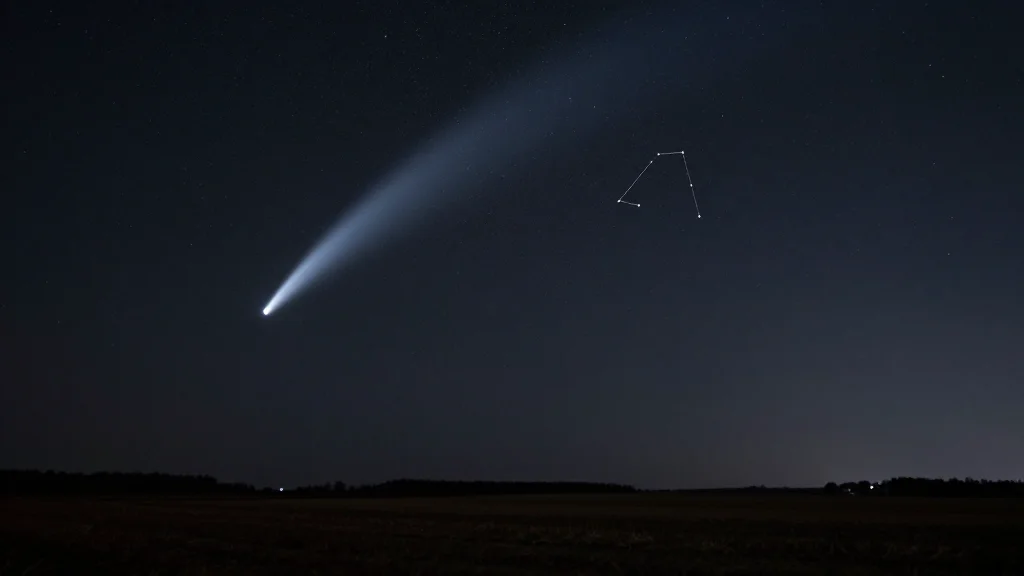
The Sky Today on Saturday, April 11: Comet Tempel 2 in Scutum
Why It Matters
Early‑summer comets give amateur astronomers rare, low‑light targets and boost public interest in night‑sky observation, while the timing challenges encourage timely outreach and planning.
Key Takeaways
- •Tempel 2 reaches 12th magnitude, visible in Scutum before sunrise
- •Comet rises ~35° above horizon at 5 A.M., near Alpha Scuti
- •PanSTARRS (C/2025 R3) shines at magnitude 5 near Markab
- •Both comets best viewed with binoculars or small telescopes before dawn
- •Tempel 2 may brighten to 4th magnitude but sets earlier nightly
Pulse Analysis
Summer’s night sky is unusually rich this year, thanks to the arrival of comet 10P/Tempel 2. Tracing an orbit that brings it close to Earth every 5.5 years, Tempel 2 now threads through Scutum, climbing to a comfortable 35° altitude before dawn. Although its current 12th‑magnitude glow demands a moderate aperture telescope, the comet’s steady brightening promises a visual payoff for observers willing to track its progress. Its proximity to deep‑sky objects like the globular cluster NGC 6712 adds a layered viewing experience, turning a simple comet hunt into a mini‑tour of the southern Milky Way.
For early risers, the real standout is comet C/2025 R3 (PanSTARRS), cruising through Pegasus at roughly 5th magnitude. Positioned just a few degrees from Markab, the brightest star in the Great Square, PanSTARRS is easily captured with binoculars or a small scope, and even a smartphone long‑exposure can reveal its faint tail. The timing is tight—rising an hour before sunrise and sinking quickly as the horizon brightens—so enthusiasts should set up before twilight to maximize exposure. Pairing the two comets in a single session offers a comparative study: one faint and distant, the other relatively bright and fast‑moving.
Beyond the immediate viewing pleasure, these comets underscore a broader trend in citizen astronomy. Mobile apps, real‑time sky maps, and affordable optics now empower hobbyists to chase transient objects that were once the domain of professional observatories. As Tempel 2 potentially climbs to 4th magnitude, it could become a naked‑eye curiosity, expanding public engagement and driving traffic to sky‑watching events. Meanwhile, PanSTARRS serves as a reminder that new comets continue to appear, keeping the night sky dynamic and inviting for both seasoned stargazers and newcomers alike.
The Sky Today on Saturday, April 11: Comet Tempel 2 in Scutum
Comments
Want to join the conversation?
Loading comments...