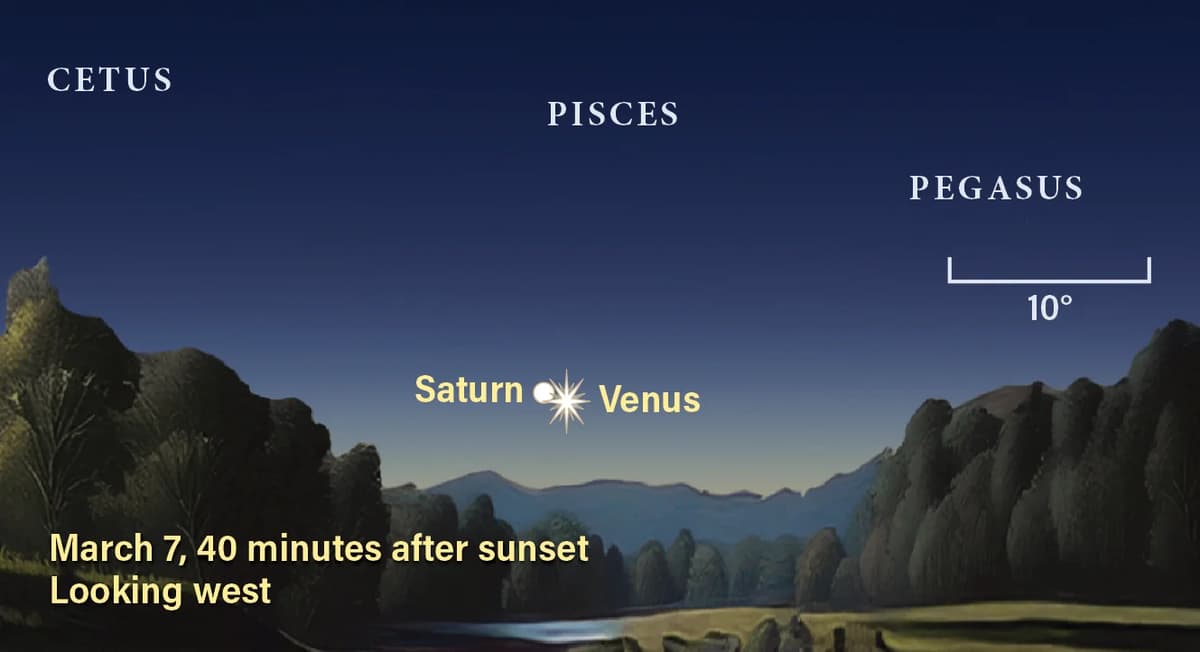
The Sky Today on Saturday, March 7: Venus Meets Saturn
•March 7, 2026
0
Why It Matters
The close pairing provides a rare, low‑light opportunity for amateur astronomers and educators to showcase planetary scale differences, driving sky‑watching participation and outreach content.
Key Takeaways
- •Venus appears 7° above horizon after sunset
- •Saturn sits ~1° southeast of Venus, visible with binoculars
- •Venus disk spans 10″, 97% illuminated gibbous
- •Saturn spans 16″; rings extend 36″ across
- •Conjunction sets ~70 minutes after sunset
Pulse Analysis
Planetary conjunctions like the March 7, 2026 Venus‑Saturn pairing are among the most accessible celestial events for the general public. Venus, the brightest object after the Sun and Moon, rises shortly after sunset, while Saturn, though fainter, becomes detectable with modest optics. This alignment highlights the stark contrast between a nearby, reflective world and a distant gas giant with prominent rings, offering a visual lesson in planetary size, distance, and illumination that few other sky events provide.
For observers at mid‑northern latitudes (around 40° N, 90° W), the optimal viewing window opens roughly 30 minutes after sunset. Locate Venus first—its brilliance makes it unmistakable—and then shift your gaze about one degree southeast to spot Saturn’s pale disc. Binoculars with 7×‑10× magnification will reveal Saturn’s rings, while a modest telescope (80‑100 mm aperture) can resolve the 16‑arcsecond planet and its 36‑arcsecond ring system. Timing is critical; the pair will dip below the horizon about 70 minutes after the Sun, so plan for quick setup and steady tracking to capture photographs or detailed sketches.
Beyond the immediate visual appeal, such conjunctions stimulate local astronomy clubs, planetariums, and tourism operators to host viewing parties and educational workshops. The event’s simplicity—no special equipment beyond basic binoculars—lowers barriers to entry, encouraging newcomers to explore the night sky. Moreover, the contrast between Venus’s gibbous phase and Saturn’s fully illuminated rings provides a tangible example for curricula covering planetary motion, illumination geometry, and observational techniques, reinforcing the broader relevance of astronomy in STEM outreach.
The Sky Today on Saturday, March 7: Venus meets Saturn
0
Comments
Want to join the conversation?
Loading comments...